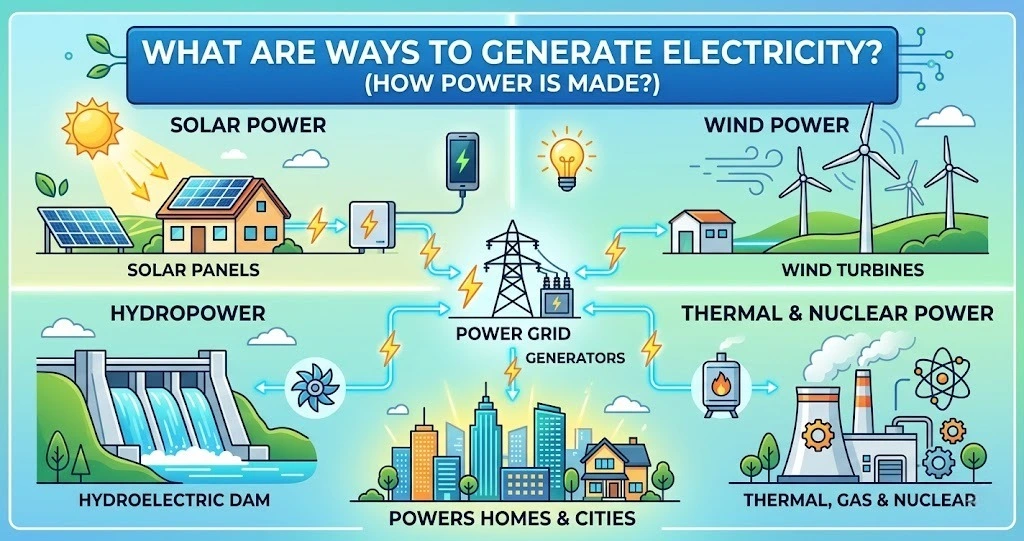
Solar panels generate electricity the moment sunlight reaches their silicon cells, a fixed piece of physics known as the photovoltaic effect. That part never changes.
What does change, and what most explanations skip, is how much electricity actually comes out the other end. This guide covers the short version of the mechanism and then goes into what really moves the needle: temperature, panel angle and shading, the three factors that determine whether a system performs close to its rated output or well below it.
Key Takeaways
- Solar panels generate electricity through the photovoltaic effect, converting sunlight directly into a DC current with zero moving parts.
- Temperature, panel angle, and shading all affect real-world output, not just the panel’s rated wattage.
- Utility-scale solar generation in the US grew 34% in 2025 alone, according to EIA data, making it the fastest-growing electricity source in the country.
- Shading damages output disproportionately. Covering just one cell out of 36 can cut a panel’s power by up to 75%.
How Do Solar Panels Create Electricity?
Solar panels create electricity when sunlight excites electrons inside their silicon cells, setting off a one-directional current. That current starts out as DC, and an inverter switches it to AC before it reaches your outlets.
The cells inside a panel are wired together to act as one unit. When photons strike the silicon, they transfer energy to electrons, freeing them from their atoms. A built-in electric field inside each cell forces those freed electrons to move in a single direction, turning scattered energy into a usable flow.
That’s the physics in a nutshell, though the deeper mechanics of how solar panels work, including the p-n junction and cell doping, go further than we’ll cover here.
But the mechanism is only half the story. The more practical question is how much of that electricity actually reaches your outlets, and that depends on more than sunlight alone.
How Do Solar PV Panels Generate Electricity? (What Actually Affects Output)
Solar PV panels generate electricity whenever photons reach the silicon cells, but three factors decide how much of that potential turns into usable power: temperature, angle, and shading.
Temperature
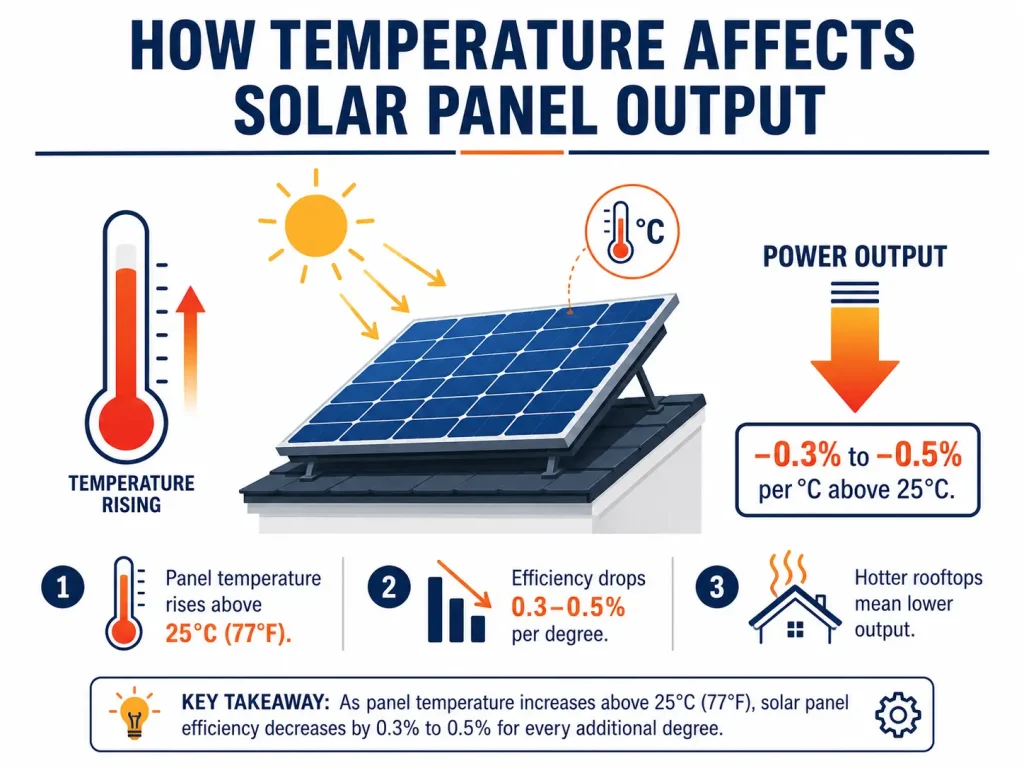
Heat is the enemy of solar output, somewhat counterintuitively. Crystalline silicon panels lose between 0.3% and 0.5% of their power for every degree Celsius above 25°C (77°F), based on manufacturer specifications and NREL-referenced research. A panel running at 45°C, common on a dark rooftop in summer, can lose 6-10% of its rated output from heat alone.
That’s why a cool, sunny day in April often outperforms a scorching one in August. Sunlight is the fuel, but heat creates friction.
Not every panel handles heat the same way, either. Thin-film panels generally carry a lower temperature coefficient than standard crystalline silicon, meaning they hold onto more of their rated output as temperatures climb, even though they start out less efficient overall. It’s a trade-off worth knowing if you live somewhere hot.
Panel Angle and Direction
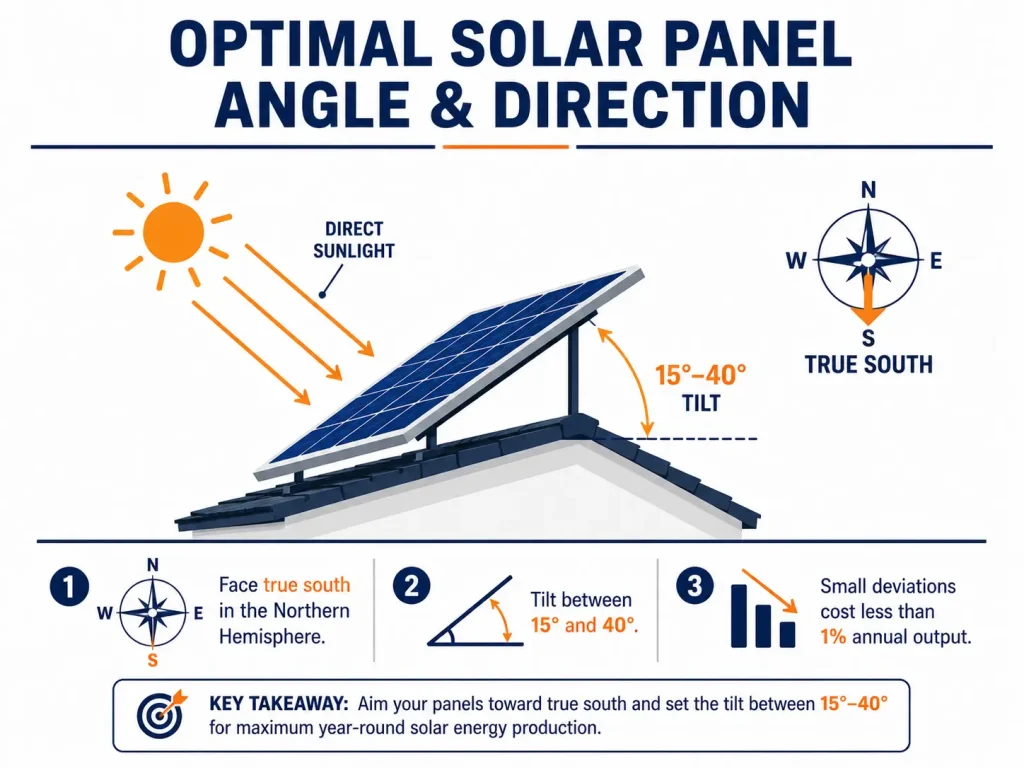
The U.S. Department of Energy recommends panels face true south (in the Northern Hemisphere) with a tilt between 15 and 40 degrees. Small deviations barely matter. The DOE’s Solar Energy Technologies Office notes that panels angled 10 degrees off the ideal direction lose less than 1% of their annual production.
Translation: don’t lose sleep over slightly imperfect roof geometry. The system is more forgiving than most sales pitches suggest.
Shading
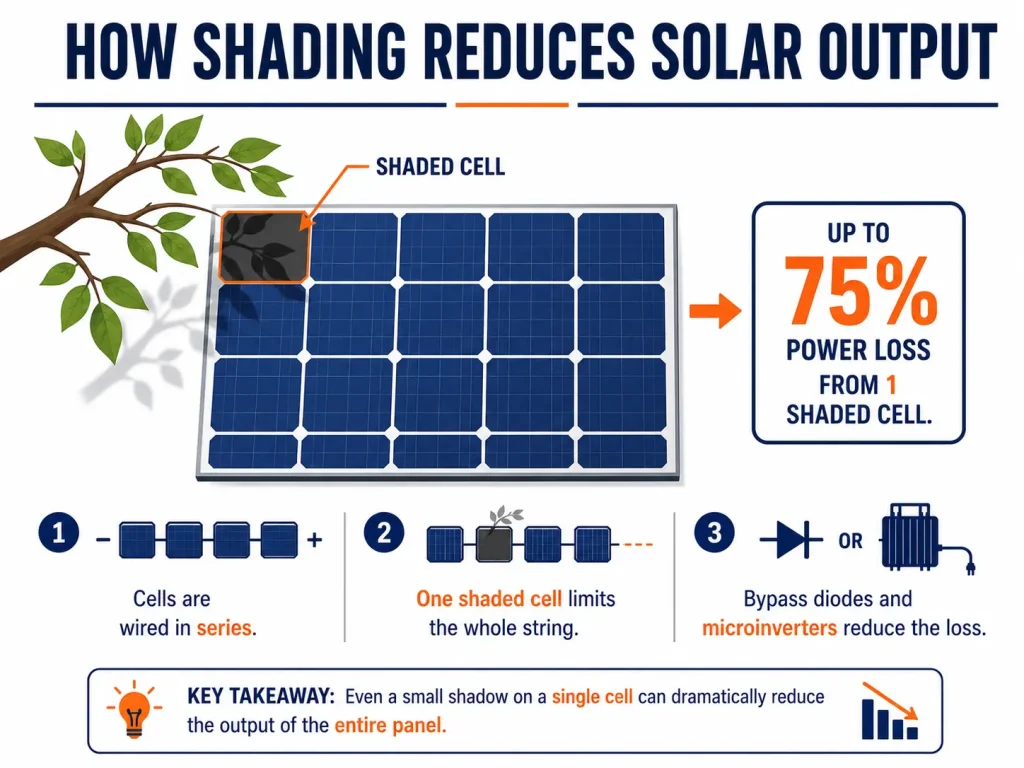
Shading punishes output disproportionately. Research on partially shaded panels shows that covering just one cell out of 36 in a small module can cut total power output by up to 75%, because cells are wired in series and the whole string follows the weakest one.
A single tree branch or chimney shadow across one corner of a panel does far more damage than the shaded area alone would suggest. This is exactly why installers care so much about a clear roofline before mounting anything.
Modern systems fight back against this with bypass diodes, which let current skip around a shaded section instead of choking the whole string, and microinverters or power optimizers, which manage each panel individually so one shaded panel doesn’t drag down its neighbors. Neither fix eliminates the loss entirely, but both limit the damage considerably.
None of this changes how solar panels generate electricity at the physics level, that part stays fixed. What changes is how much of that generated electricity you actually get to use.
How Much Power Does a Solar Panel Produce?
A typical residential solar panel rated between 350 and 450 watts produces roughly 1.5 to 2 kWh per day under average US sunlight conditions, though real output shifts with the factors above.
Understanding how solar panels generate electricity at scale means looking past a single rooftop and toward the grid.
| Metric | 2025 Value | Change vs. 2024 |
| Utility-scale solar generation | 296,000 GWh | +34% |
| Small-scale (rooftop) solar generation | 93,000 GWh | +11% |
| Combined solar share of total US generation | ~9% | Fastest-growing source |
Source: U.S. Energy Information Administration (EIA), Electric Power Monthly, 2025 data.
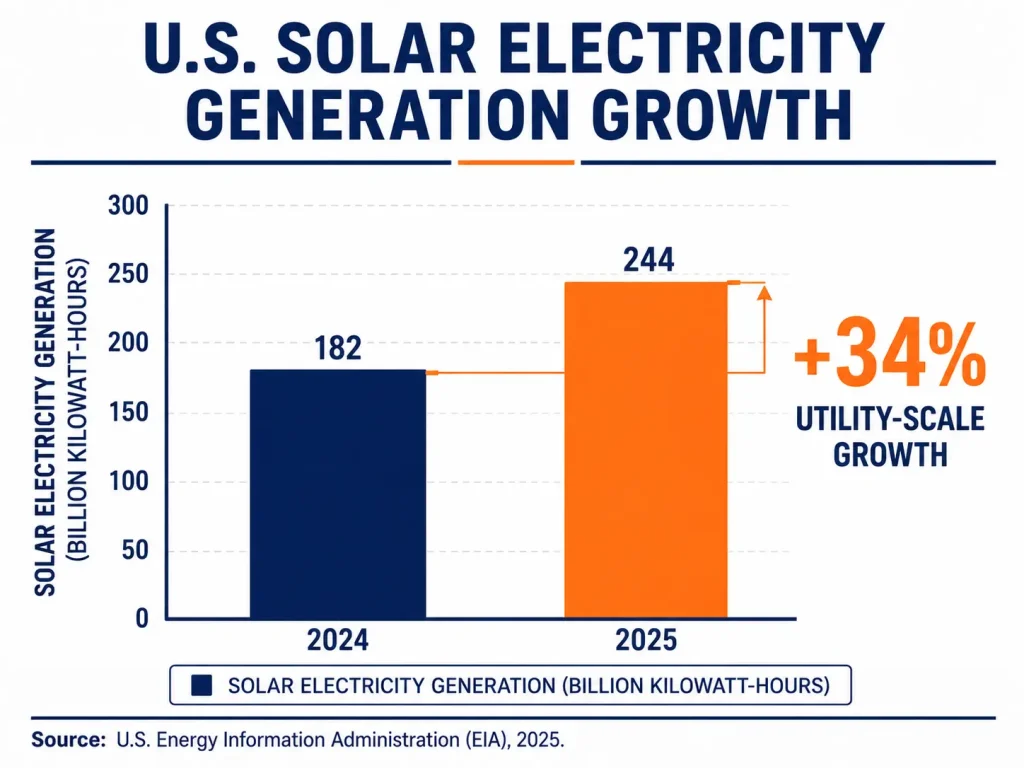
That 34% jump in utility-scale generation isn’t a one-year blip. Solar generation has increased every year in the US since 2006, and the EIA expects continued double-digit growth as new capacity keeps outpacing every other energy source.
The EIA’s Short-Term Energy Outlook projects utility-scale solar generation climbing from roughly 290 billion kWh in 2025 to about 424 billion kWh by 2027, a jump largely driven by nearly 70 gigawatts of new solar capacity scheduled to come online in 2026 and 2027 alone. Whatever the exact final numbers turn out to be, the direction is not in question.
So how much power does a solar panel produce over its full lifetime? Take a modest 1.7 kWh daily average, factor in a slow annual degradation rate of about 0.5% (per NREL’s PV performance research), and a single 400-watt panel generates somewhere around 14,000-15,000 kWh across its 25-year warranty period.
How Do Solar Panels Generate Power? (The Full Picture)
Solar panels generate power through a fixed physical process that runs from sunlight to electron flow to DC to AC. The power you actually receive, though, depends on the system working around that core mechanism. Panel angle, local climate, shading, and inverter efficiency all stack up together.
Think of the photovoltaic effect as the engine. Tilt, temperature, shade, and wiring are the transmission. A great engine with a bad transmission still underperforms.
This is also why two identical panels on two different roofs can produce noticeably different annual totals. The cells generate power identically. The environment around them doesn’t.
Solar also stands apart from most other ways to generate electricity, since it skips the turbine entirely and converts sunlight directly into current, no spinning parts required.
Frequently Asked Questions
How do solar panels generate electricity in simple terms?
Light energizes electrons inside the panel’s silicon cells, and that movement forms a current. The current leaves the panel as DC, then an inverter switches it to the AC form your home runs on.
How do solar PV panels generate electricity differently from solar thermal systems?
Solar PV panels generate electricity directly through the photovoltaic effect, with no moving parts. Solar thermal systems instead use sunlight to heat water or fluid, which can drive a turbine or supply heating separately.
How much power does a solar panel produce on a cloudy day?
A solar panel typically produces 10-25% of its clear-sky output on an overcast day, since diffused sunlight still reaches the cells, just at lower intensity.
Does panel angle really matter that much?
Less than most people assume. Deviating up to 10 degrees from the ideal direction costs less than 1% of annual output, according to the DOE. Tilt is even more forgiving than direction.
Do solar panels generate power in winter?
Yes, and sometimes more efficiently, since cold temperatures reduce the heat-related power loss covered above. Shorter daylight hours offset some of that gain, but cold, sunny days perform well.
Why do two identical solar panels produce different amounts of electricity?
Identical panels can still produce different totals because of their surrounding conditions, not the hardware itself. Roof angle, local shading, ambient temperature, and even dust buildup all change real-world output, even when the panels themselves are the same model and wattage.
Conclusion
How solar panels generate electricity comes down to one fixed process, sunlight knocking electrons loose inside silicon cells, and one variable reality: temperature, angle, and shading all shape how much of that electricity you actually get.
The physics is the same. That depends on where the panel is and how well it is kept clear. Position it right, keep it out of the shade, and the numbers justify the investment.
For the deeper mechanical walkthrough, including cell types and system components, How Do Solar Panels Work? covers it in full.
Research
Research for this article was supported by publications from the U.S. Energy Information Administration (EIA), the U.S. Department of Energy’s Solar Energy Technologies Office (DOE), and the National Renewable Energy Laboratory