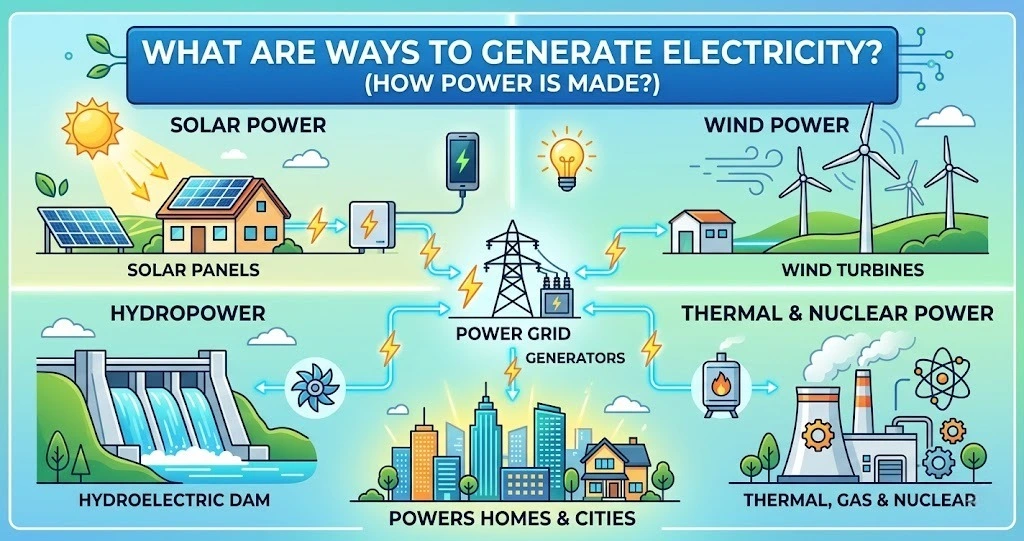
You flipped a switch, and a light turns on. It looks just simply, right? But behind this switch, one of the most fascinating processes of physics is at work. So, how does electricity work? In short, tiny particles called electrons move through a material, and this movement generates an electric current. Voltage pushes the current, and the two work together to power everything from your phone charger to your refrigerator.
That was the short summary. Here is the complete picture, with every single part.
Key Takeaways
- Electricity is the movement of electrons through a material, not a substance in itself.
- Electrons move freely in conductors like copper but encounter resistance to flow in insulators like rubber.
- Voltage pushes the current forward, while resistance opposes it. The two balances out through Ohm’s Law.
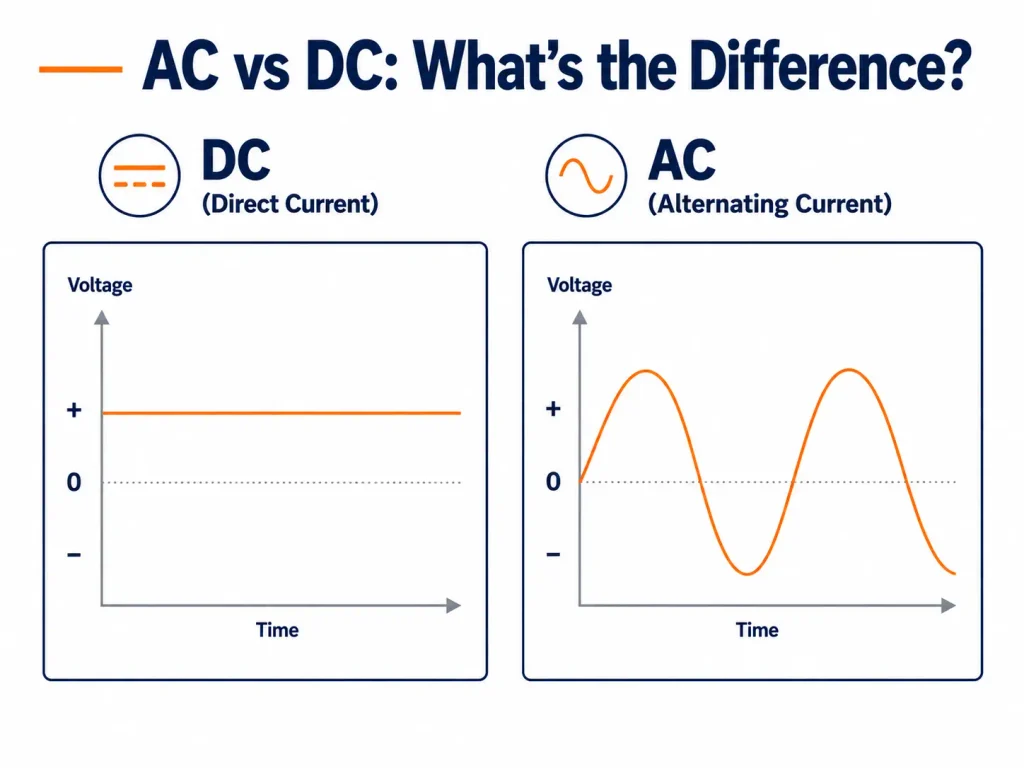
- In DC, current flows in a constant direction, whereas in AC, it repeatedly changes its direction.
- How electricity works comes down to three ideas working together: electrons, voltage, and current.
What is Electricity, exactly?
Electricity is the flow of electric charge. That’s the textbook definition, and it’s accurate, but it doesn’t explain much on its own.
To understand it, start with the atom. Every atom has a nucleus at its center, made up of protons and neutrons. Electrons orbit around that nucleus. Protons carry a positive charge, electrons carry a negative charge, and neutrons carry no charge at all.
So, is electricity an element?
No. Electricity is not something you can hold in your hand, nor is it a substance like oxygen or gold. It is a phenomenon or process that occurs when charged particles move. Think of it less like a “thing” and more like an event, similar to how wind isn’t a material either. It’s air in motion.
That difference is important because it’s exactly what electricity is made of: not one specific substance, but the movement of electrons between atoms. When a number of electrons move in the same direction through a material, an electric current is generated, and current is what actually does the work.
What Do Electrons Do?
Electrons are the key and fundamental dynamic elements of the entire system. In some materials such as copper or aluminum, the outermost electrons are not tightly bound to their atoms. They can break free and flow towards a nearby atom.
On their own, in a random material, these loose electrons just wander in every direction. Nothing productive happens. But apply an electric field, and suddenly all those electrons start moving in the same direction at once. That coordinated movement is current.
Copper conducts electricity easily. Rubber basically shuts it down. The reason comes down to those outer electrons again: loose on copper and locked tight on rubber. They’re free to drift around. Rubber and glass work the opposite way. Their electrons stay locked in place. That blocks the flow almost entirely. It’s actually why a standard wire is built the way it is. Copper on the inside so electrons can move. Rubber wrapped around the outside so they don’t end up somewhere they shouldn’t.
The scale here is worth pausing on. A single electron carries almost no charge on its own. You need about 6.24 quintillion of them moving past one point every second just to get one amp, which is roughly what a phone charger pulls. Nobody’s counting electrons one by one, obviously. That’s the whole reason analogies like flowing water exist. They make an invisible, impossibly fast process feel like something you can actually picture.
How Does Current Flow?
Here’s where a simple analogy helps more than a wall of technical terms.
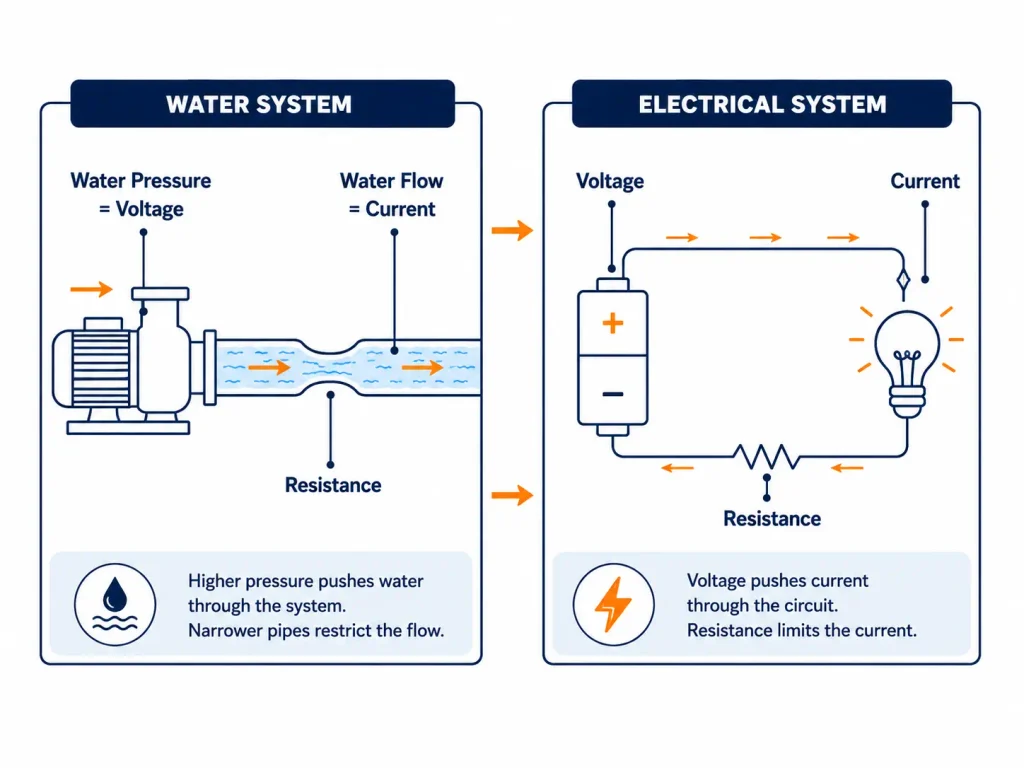
Picture a garden hose. Water flowing through the hose is like current. The water pressure pushing it along is like voltage. The narrower the hose, the more resistance the water meets. Swap “water” for “electrons,” and you’ve got the basic idea of how current flows.
Now for the part that trips up almost everyone: which direction does current actually flow? Electrons, being negatively charged, physically move from the negative terminal of a battery toward the positive terminal. But by long-standing convention, established before scientists even discovered electrons, engineers describe current as flowing from positive to negative.
Both descriptions are technically valid. This is called the conventional flow of electricity, and it’s simply the direction engineers agreed to use for describing circuits, even though it’s the opposite of the electrons’ actual physical movement. It’s a bit like reading a story that was translated backwards. The plot still holds together as long as everyone uses the same translation.
Electrons crawl through a wire way slower than you’d think, sometimes just a fraction of a millimeter per second. What travels fast is the electric field itself, close to the speed of light. So when you flip a switch, the bulb lights up instantly even though the electrons sitting right next to it barely budged. The push gets there almost immediately. The electrons themselves are basically taking their time.
What Is Voltage?
Let’s take an example of a water pipe. If current is the water, then voltage is the water pressure. If you increase the pressure, more water flows through the hose. If you increase the voltage, more electrons are pushed through the wire.
Voltage is technically the difference in electrical potential between two points in a circuit. That difference is what motivates electrons to move in the first place. No voltage, no push, no current.
In the United States, standard household outlets deliver around 120 volts, according to the U.S. Energy Information Administration. That’s the “pressure” behind everything plugged into a wall socket at home, from lamps to microwaves.
There’s a simple relationship connecting all three ideas: current, voltage, and resistance. It’s called Ohm’s Law, and it looks like this:
Voltage (V) = Current (I) × Resistance (R)
You don’t need to memorize the math to understand the concept. Just remember that more voltage means more push, and more resistance means more pushback. The two works against each other, and current is what comes out of that balance.
How Does AC Electricity Work?
So far, current has been flowing in one steady direction, like water through a hose. That’s called Direct Current, or DC. Batteries and solar panels produce DC electricity.
But most of the electricity flowing into homes doesn’t behave that way. Instead, it constantly reverses direction, back and forth, dozens of times per second. That’s Alternating Current, or AC. In the United States, the standard power grid runs on AC electricity at a frequency of 60 hertz, meaning the current reverses direction 60 times every second.
Why Does AC Electricity Work This Way Instead of DC?
It comes down to efficiency. AC voltage can be raised or lowered easily using transformers, stepping it up to very high voltages for long-distance transmission and back down to safer levels before it reaches your home. That flexibility is what makes AC far more practical for sending electricity across power lines than DC, which is much harder to convert between voltage levels once it’s already flowing. That’s also exactly why devices need an inverter to switch between the two: solar panels generate DC, but most home appliances and the grid itself run on AC.
Here’s a quick side-by-side comparison:
| Property | AC (Alternating Current) | DC (Direct Current) |
| Direction of flow | Reverse’s direction repeatedly | Flows in one constant direction |
| Common sources | Power grid, wall outlets | Batteries, solar panels |
| Common uses | Home appliances, lighting, HVAC systems | Phones, laptops, electric vehicles |
| Why it’s used | Easier to transmit over long distances | Simple, stable power for electronics |
That difference between AC and DC is also exactly how an inverter works: it converts DC power from a battery or solar panel into the AC power that most household devices expect.
Frequently Asked Questions
How does electricity work step by step?
Electrons in a conductive material move when voltage is applied, creating current. That current flows through a circuit, powering whatever device is connected, whether it’s a light bulb or a laptop charger.
How do you explain electricity in simple terms?
Electricity is the movement of tiny charged particles called electrons. Voltage pushes them, resistance slows them down, and the resulting flow, called current, does the work of powering your devices.
What’s the difference between AC and DC electricity?
AC electricity repeatedly changes direction and powers the majority of household appliances via the grid. DC electricity flows in a single, constant direction and is obtained from sources such as batteries and solar panels.
Is electricity an element?
No. Electricity is not an element or a solid substance. This is a process that occurs when an electric charge (usually carried by electrons) passes through a material.
Research
This article draws on atomic structure and current flow data from the U.S. Energy Information Administration and the AC frequency standard confirmed by Stanford University’s Understand Energy Learning Hub.