What is electrical load? It is the total amount of power drawn by your home when all connected devices are turned on at the same time, from the kitchen lights to the washing machine in the middle of its cycle. That number directly affects how safely your wiring and panel perform.
More homeowners are asking this question lately. EV chargers, hot tubs, and heat pumps push older panels closer to their limit than they were ever designed to handle. Knowing this number, and how to calculate it properly, is what stands between a smooth panel upgrade and an expensive surprise.
This guide explains electrical load in plain terms, breaks down the types you will actually run into, and walks through the same calculation method licensed electricians use, step by step.
Key Takeaways
- Electrical load is the total power demand placed on a circuit or system by connected devices.
- The basic formula is Watts = Volts × Amps.
- The National Electrical Code requires a load calculation before installing or upgrading most residential electrical services.
- Getting this number wrong risks tripped breakers, overheating wires, and, in the worst cases, electrical fires.
What Is Electrical Load?
What is electrical load in plain English? It’s the amount of electric power a device or a group of devices draws while running. A single lamp has a small load. A central air conditioner has a much bigger one. Add every connected device together, and you get the total load on that circuit or panel.
So, what is an electrical load in practice? It’s the real-time draw of everything switched on and connected to that circuit, added together, no more and no less.
This number matters because your home’s wiring, breakers, and main panel can only handle so much power safely. Electricians measure load in watts or volt-amperes, and it directly connects to volts and amps, since power is simply the product of the two. Your home’s total electrical load capacity is set by your service panel rating, and every calculation in this guide works toward comparing your actual demand against that ceiling.
Most US homes run on a split-phase 120/240-volt service. Smaller circuits, like lighting and outlets, use 120 volts. Larger appliances, like your dryer or range, use 240 volts to move more power through the same wire without needing an unreasonably thick cable.
Electrical loads generally fall into three types, resistive, inductive, and capacitive. Each behaves differently on a circuit, and knowing which is which makes the rest of this guide much easier to follow. Once you can explain what an ‘electrical load’ is without hesitation, identifying its type becomes second nature to you.
What Are the Different Types of Electrical Load?
Now that you know what is an electrical load in general terms, the next question is what form it actually takes in your home. Electrical loads can be classified in two different ways, by their electrical nature or by how they’re actually used in a building. Most guides only cover one. We’ll cover both, because a homeowner sizing a panel and an engineer designing a commercial feeder are usually asking slightly different questions.
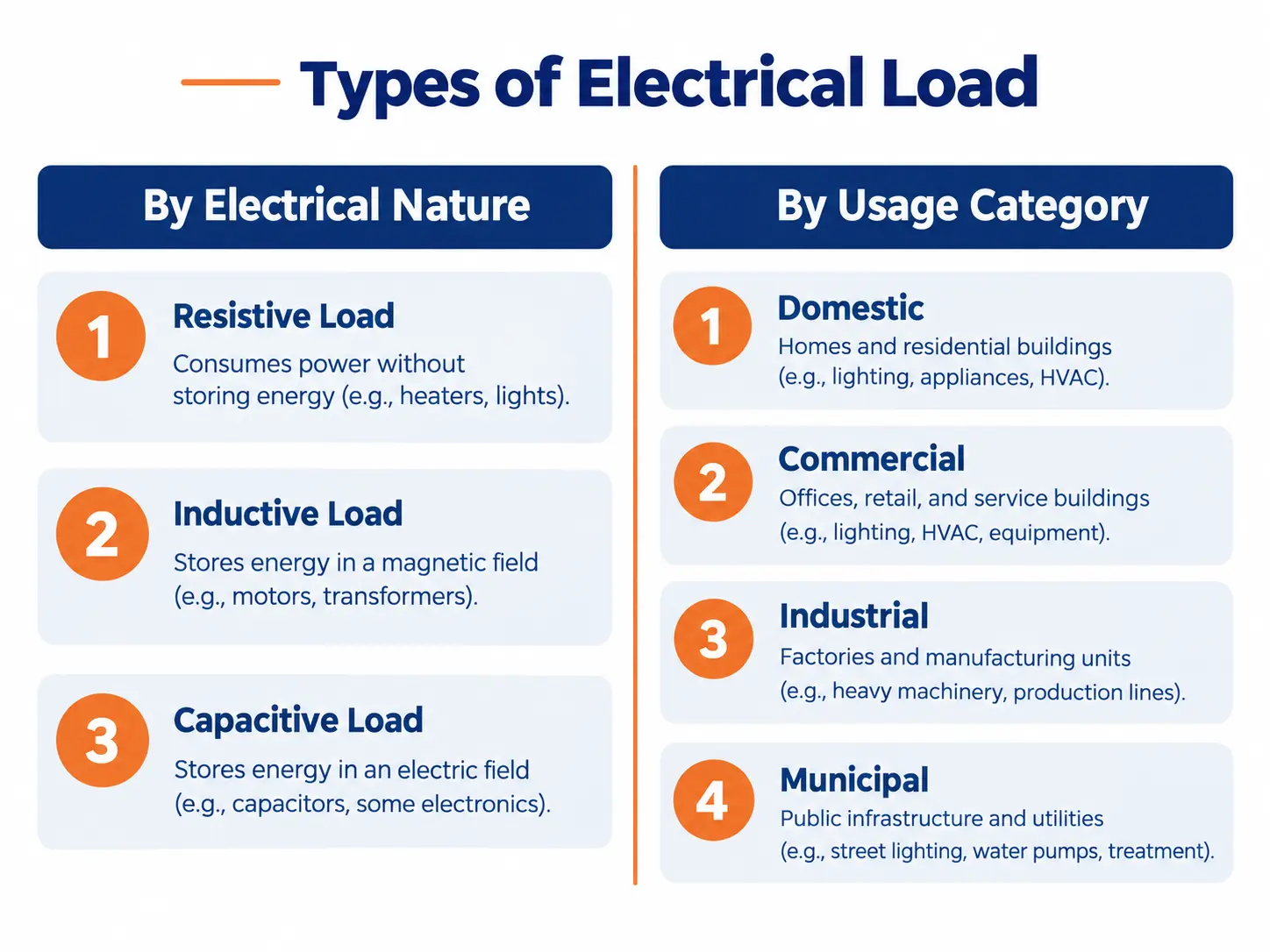
Types of Electrical Load by Electrical Nature
Resistive loads:
They convert electricity directly into heat or light, with no phase shift between voltage and current. Toasters, incandescent bulbs, and electric water heaters fall here. They’re the simplest loads to calculate.
Inductive loads:
They use a magnetic field to do their work, which creates a lag between voltage and current. Motors, refrigerator compressors, and air conditioners are inductive. They tend to draw a brief surge of extra current when they first start up, which is why HVAC circuits often need extra headroom.
Capacitive loads:
They store energy in an electric field and release it back into the circuit. These are less common in a typical home but show up in certain electronic devices and power factor correction equipment.
Most homes are a mix of all three, though resistive and inductive loads make up the bulk of what you’ll actually calculate. Knowing the difference matters because inductive loads need extra breathing room in your calculation for that startup surge, something a purely resistive load like a toaster never asks for. This mix is exactly what the electrical load is in a real house, not one single number but several types working together.
Types of Electrical Load by Usage Category
Loads are also grouped by where and how they’re consumed, as shown below.
| Category | Typical Examples | Load Pattern |
| Domestic | Lighting, kitchen appliances, HVAC | Fluctuates through the day, peaks in the morning and evening |
| Commercial | Office equipment, retail lighting, elevators | Steady during business hours |
| Industrial | Motors, compressors, heavy machinery | High and often continuous |
| Municipal | Street lighting, water pumping, traffic signals | Predictable, mostly overnight or scheduled |
A homeowner only really needs the domestic category, but understanding the full picture helps explain why utility companies plan capacity so differently across a city.
Connected Load vs Demand Load
Here’s something most guides skip entirely, and it trips people up constantly. Connected load is the sum of every single device’s rated wattage if it all ran at once. Demand load is what actually gets used, since nobody runs every appliance in the house at full power simultaneously.
Your oven, dryer, and every light fixture combined might add up to a connected load of 30,000 watts. In reality you rarely use all of them together, so the National Electrical Code allows demand factors that reduce this number to something realistic. That’s why the formula in the next section isn’t just addition. It has a discount for loads you won’t actually run at the same time. That gap between the connected number and the real number is really what is electrical load in practice, a moving target rather than a fixed sum.
This distinction is exactly why two homes of the same size can end up with different required service sizes. A home with mostly small, occasional loads calculates a lower demand than one running a workshop, a pool pump, and central air all through the same panel.
Why Electrical Load Matters
Make sure to avoid figuring out what is the electrical load in your own home, and the consequences show up fast. Breaker’s trip. Wires overheat. In the worst cases, poor load management contributes to house fires
Planning to add a hot tub, an EV charger, or a home addition? Your electrician needs an accurate load calculation before pulling a permit. It’s not paperwork for the sake of paperwork. It determines whether your existing 100-amp service can handle the new load or whether you need a costly upgrade to 200 amps. The same logic applies when sizing a backup generator, since an undersized one won’t carry your essential circuits through an outage.
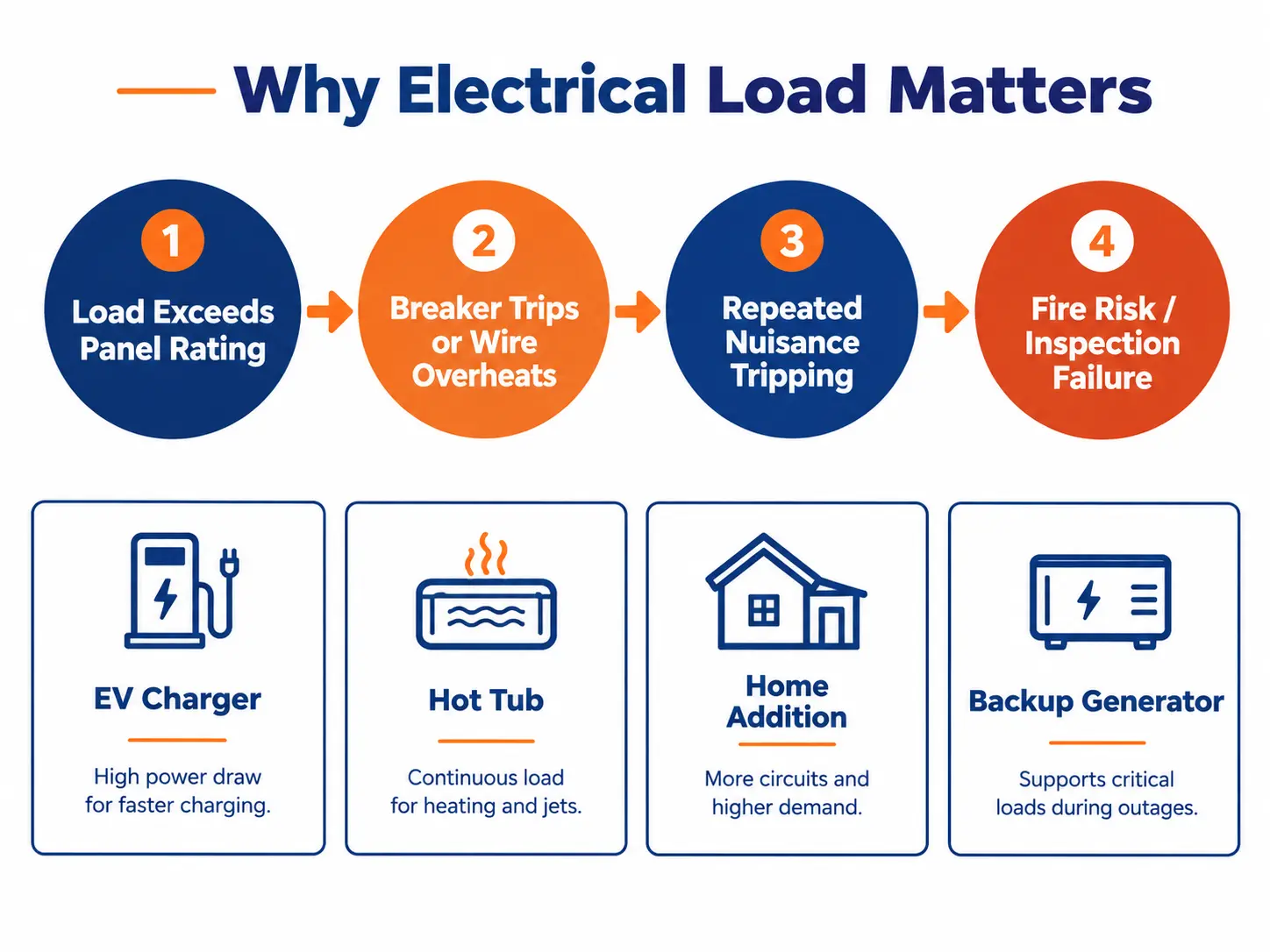
There’s also a rule most homeowners never hear about until it affects them. The NEC requires continuous loads, meaning anything expected to run for three hours or more, to be calculated at 125 percent of their rating rather than their actual draw. An EV charger running overnight is a textbook continuous load, which is one reason adding one often pushes an older panel past its limit even when the math seems to leave room on paper.
Getting this number right the first time saves money, prevents nuisance tripping, and keeps your home genuinely safe.
How to Calculate Electrical Load
Once you understand what the electrical load concept is, the math becomes far less intimidating. Do you want to know how to do an electrical load calculation without calling an electrician just to get a rough number? Calculating electrical load follows one simple formula, applied through a clear step-by-step process. When you look at it in detail, it feels far less frightening than it sounds.
The Basic Formula
Every electrical load calculation starts with one core relationship. This is what is electrical load reduced to pure math, nothing more than volts multiplied by amps.
Watts = Volts × Amps
A standard US household circuit runs at 120 volts. A device pulling 10 amps on that circuit uses 1,200 watts. That’s the entire foundation. Everything else in a full home load calculation is this same formula, applied appliance by appliance, then adjusted with code-required demand factors.
To quickly convert watts to amperes, simply reverse the formula: amperes are equal to watts divided by volts.
A small complication worth knowing about. For a purely resistive load, watts and volt-amperes are the same value. For inductive loads, such as motors, they may differ slightly due to the power factor, which measures how effectively the current is converted into usable work. NEC load calculations use volt-amperes specifically because it accounts for this difference.
Step-by-Step Process
Here’s the process for calculating electrical load in a home, following the NEC standard method.
- Add up general lighting and receptacle load at 3 volt-amps per square foot of living space.
- Add small appliance and laundry circuits, typically 1,500 VA per required circuit.
- Apply the demand factor. The first 3,000 VA counts at 100 percent, and the remainder counts at 35 percent.
- Add the nameplate rating for large fixed appliances like the water heater, range, and dryer.
- Add the larger of your heating or cooling load, never both, since they don’t run together.
- Divide the total volt-amps by your service voltage to get the required amperage.
Worked Example
This worked example applies the load calculation formula from start to finish, showing how to do an electrical load calculation for a 2,000 square foot home, using real NEC figures.
General lighting and receptacle load comes to 2,000 sq ft × 3 VA, or 6,000 VA. Two small appliance circuits at 1,500 VA each add 3,000 VA, and one laundry circuit adds 1,500 VA. That’s 10,500 VA before any demand factor.
Apply the demand factor. The first 3,000 VA stays at 100 percent. The remaining 7,500 VA drops to 35 percent, or 2,625 VA. The subtotal comes to 5,625 VA.
Now add the big fixed loads. An electric range adds roughly 8,000 VA of demand, a dryer adds about 5,000 VA, and a water heater adds around 4,500 VA.
Total demand comes to roughly 23,125 VA. Divide by 240 volts, and you land on about 96.4 amps. Round up, and this home needs a minimum 100-amp service.
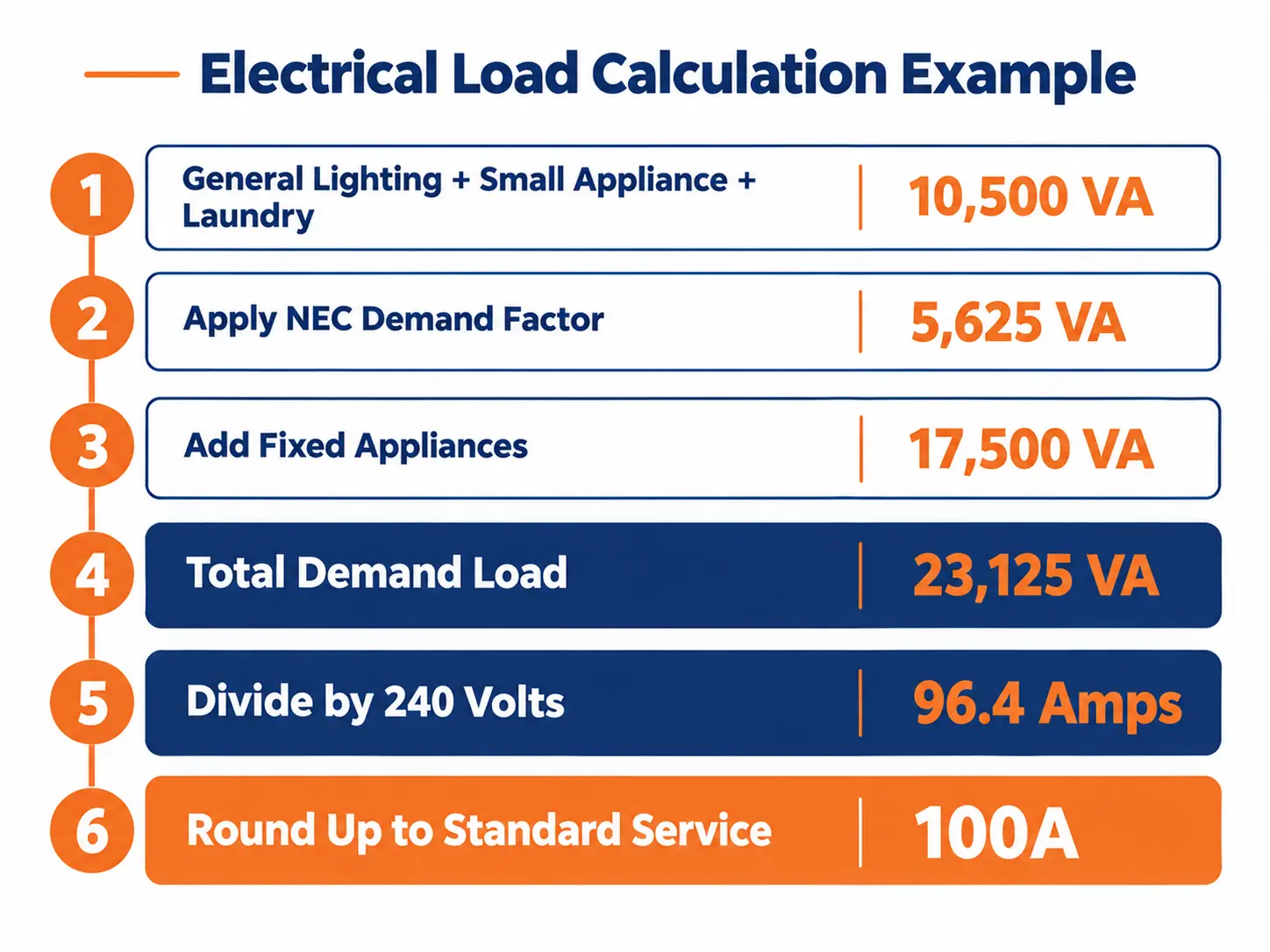
That’s not an estimate pulled from thin air. It’s the actual standard method laid out in NEC Article 220, and it’s the same math a licensed electrician runs before signing off on a panel.
Notice how close that number sits to the 100-amp threshold. This is exactly why many electricians recommend sizing up to the next standard rating, such as 125 or 150 amps, whenever a calculation lands close to a boundary. It leaves room for a future EV charger or workshop addition without forcing a second panel upgrade a few years later.
Electrical Load Calculation Formula in Practice
Everything up to this point has explained what is electrical load and how to measure it. Now it’s time to match that number against your panel. Once you know how to calculate electrical load, the final step is simple, compare your total demand to your panel’s rated capacity. Standard residential services come in 100A, 125A, 150A, and 200A ratings.
This is also where circuit breaker sizing comes in. Each individual circuit gets its own breaker sized to protect the wire gauge feeding it, not just the total panel.
| Breaker Size | Common Wire Gauge | Typical Use |
| 15 amp | 14 AWG | Lighting, general outlets |
| 20 amp | 12 AWG | Kitchen and bathroom receptacles |
| 30 amp | 10 AWG | Dryers, window AC units |
| 50 amp | 6 AWG | Electric ranges, EV chargers |
Your total load calculation determines the panel size, while individual circuit loads determine each breaker inside it. Mixing this up, like running a 20-amp breaker on 14-gauge wire, is a genuine fire hazard and a common inspection failure.
If your calculated demand comes close to your existing panel’s rated capacity, that’s your sign to talk to an electrician about a service upgrade before adding anything new. A panel running consistently near its limit ages faster and trips more often, even if nothing is technically wrong yet.
Frequently Asked Questions
What is an example of an electrical load?
A light bulb, a refrigerator, a hair dryer, or an air conditioner are all examples. Each one draws a specific amount of power measured in watts, and together they make up the total load on your home’s electrical system.
What are the three types of electrical load?
The three main types are resistive, inductive, and capacitive. Resistive loads convert power directly to heat or light, inductive loads use magnetic fields and include motors, and capacitive loads store energy in an electric field.
What is the formula for calculating electrical load?
The basic formula is Watts equals Volts multiplied by Amps. For a full home calculation, this gets applied to each appliance, then adjusted using NEC demand factors for lighting and large fixed loads.
How do I calculate the electrical load for a residential building?
Add lighting, appliance, and laundry circuit loads, apply the NEC demand factor, then add fixed appliances and the larger of heating or cooling. Divide the total by your voltage to get the required service amperage.
Research
Research for this article was supported by the National Fire Protection Association, which publishes NEC Article 220, the standard method used in this guide. The Building America Solution Center, run by Pacific Northwest National Laboratory under the U.S. Department of Energy, backs up the same figures.