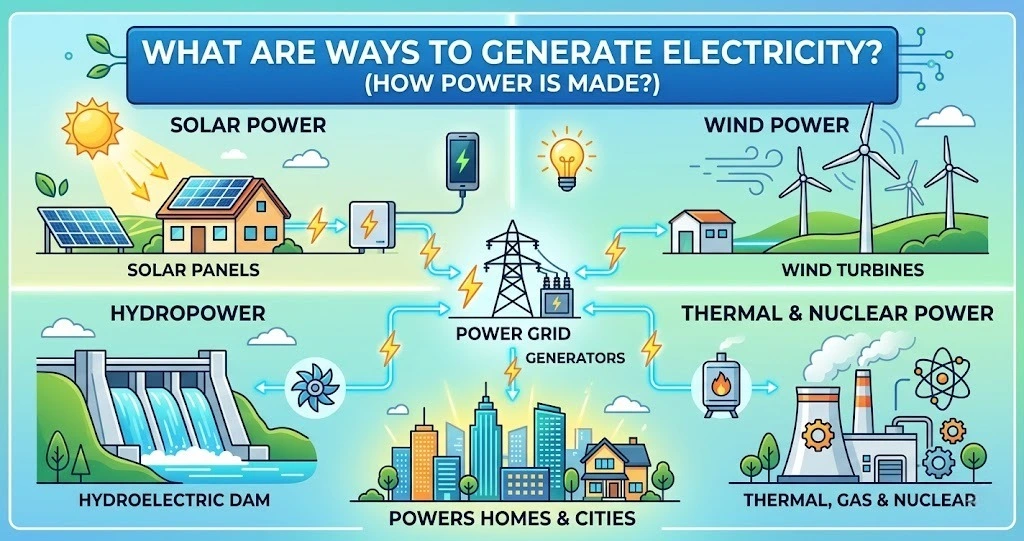
Every day, the majority of people pass humming metal boxes without giving them much thought. These devices keep the lights on across entire cities. How does a transformer works is one of the most practical questions in electrical engineering, and the answer is cleaner than most textbooks make it sound.
The physics is straightforward, the logic holds up, and once you get it, you’ll never look at a power line the same way again. This article covers how a transformer works from the ground up, including principles, parts, types, and the real numbers behind it.
How Does a Transformer Work? (Short Answer)
A transformer works by passing alternating current through a primary coil, which creates a changing magnetic field in an iron core. That changing field induces a voltage in a secondary coil, delivering electricity at a different voltage level. This process is called electromagnetic induction.
What Is a Transformer?
A transformer is a static electrical device that transfers electrical energy between two or more circuits through electromagnetic induction. It has no moving parts, which is part of why transformers are so reliable and long-lasting.
The core job of a transformer is to change voltage levels. It either steps voltage up or steps it down, depending on what the application needs. Power plants, substations, household appliances, and mobile charger transformers are everywhere.
One very important thing to note: transformers only work on alternating current (AC), not direct current (DC). This isn’t a design flaw. It’s physics, and I’ll explain why shortly.
The Core Working Principle of a Transformer
The transformer working principle is based on two laws of physics working together:
1. Faraday’s Law of Electromagnetic Induction
A changing magnetic field induces a voltage in a nearby conductor.
2. Mutual Induction
When two coils share a magnetic field, a changing current in one coil induces a voltage in the other.
Here’s how it plays out inside a transformer:
A constantly shifting magnetic field is produced around the core when AC passes through the primary winding, also known as the input coil. The field continuously reverses direction because it is an alternating current. This is the “changing” part that makes the whole thing work.
That changing magnetic flux travels through the iron core and reaches the secondary winding (the output coil). According to Faraday’s Law, the changing flux induces a voltage in the secondary coil. That’s your output voltage.
This is the principle and working of a transformer in its simplest form: electrical energy → magnetic energy → electrical energy again. No wires connecting the two coils. No direct contact. Just a shared magnetic field doing all the work.
Why not DC?
Direct current creates a constant (not changing) magnetic field. A constant field doesn’t induce any voltage in the secondary winding. No change = no induction = no output. That’s why transformers need AC.
Main Parts of an Electrical Transformer
Understanding how does an electrical transformer works becomes a lot clearer when you know what’s inside it.
| Component | Role |
| Primary Winding | Receives the input AC voltage; creates the magnetic field |
| Secondary Winding | Receives the induced voltage; delivers output power |
| Iron Core | Guides the magnetic flux between the two windings |
| Insulation | Separates windings electrically; prevents short circuits |
| Transformer Oil / Cooling System | Dissipates heat in large transformers |
The iron core warrants a separate mention. If it wasn’t there, then most of the magnetic field from the primary coil would just scatter out into open space and not get to the secondary coil. The magnetic flux is directed along a controlled path through the secondary winding by a ferromagnetic core in a loop. This makes transformers much more efficient.
The Turns Ratio (How Voltage Changes)
The ratio of turns between the primary and secondary windings determines whether a transformer steps voltage up or down. This is called the turns ratio.
The governing formula is
Vs / Vp = Ns / Np
Where:
- Vs = secondary voltage
- Vp = primary voltage
- Ns = number of turns in secondary winding
- Np = number of turns in primary winding
If the secondary has more turns than the primary, voltage goes up (step-up transformer). If it has fewer turns, voltage goes down (step-down transformer).
Here’s the catch: power is conserved. A transformer doesn’t generate energy. So if voltage goes up, current goes down and vice versa. Think of it like squeezing a balloon: push on one side, and the other side expands.
What Is a Step-Up Transformer?
A step-up transformer increases voltage from the primary winding to the secondary winding. It does this by having more turns on the secondary side than the primary side.
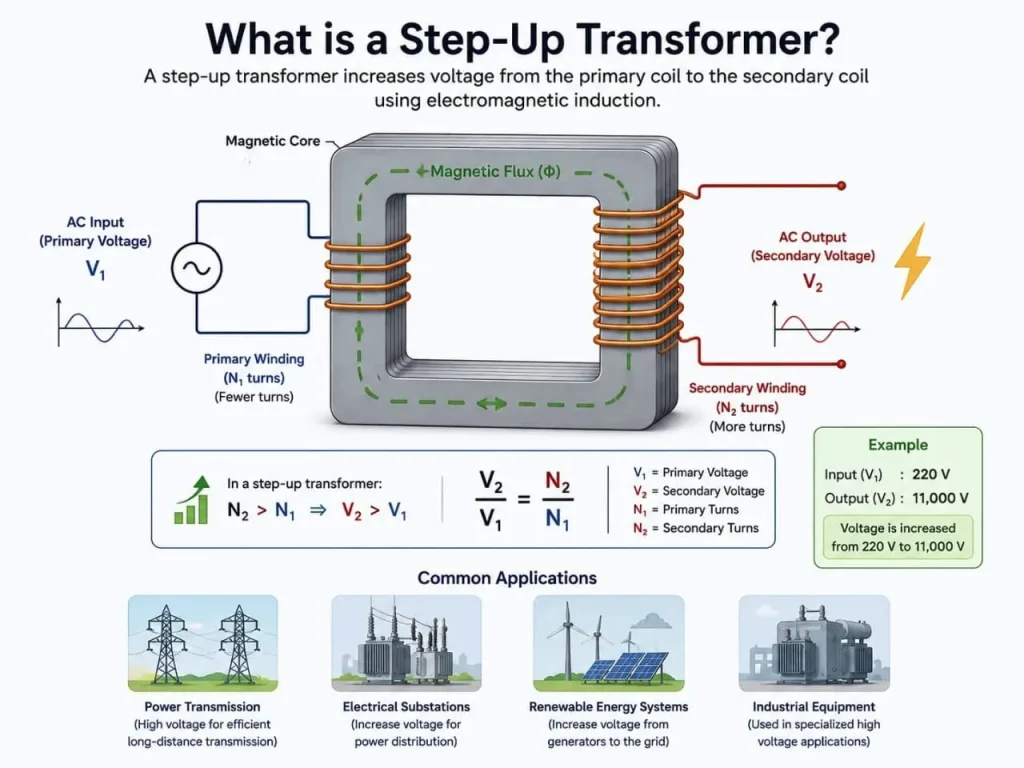
For example, if the turns ratio is 1:10 and the input voltage is 11 kV, the output becomes 110 kV. That’s exactly how power plants push electricity onto high-voltage transmission lines.
Why bother stepping voltage up?
As high voltage transmission significantly reduces energy loss over long distances. The current is low, but the voltage is high. And energy loss in a wire goes as the square of the current (I²R losses). So doubling the voltage reduces the transmission losses by a factor of four. It is not a little thing. That’s why modern power grids work at all.
Large utility step-up transformers (called Generator Step-Up or GSU transformers) typically achieve efficiencies exceeding 98%.
How Does a Step-Up Transformer Work?
How does a step-up transformer works follows the same electromagnetic induction principle as any other transformer; the only difference is the winding configuration.
The primary coil has fewer turns. The secondary coil has more. When AC enters the primary, it generates a changing magnetic flux in the core. That flux hits the secondary coil, which has more turns wound around it. More turns = more voltage induced.
The step-up transformer operates based on Faraday’s Law, and the key formula is:
Vs = (Ns / Np) × Vp
So if Ns > Np, output voltage is always higher than input voltage. The current, however, drops proportionally because power in must equal power out (minus small losses).
Step-up transformers are used in:
- Power generation plants (boosting generator output for grid transmission)
- Radio and TV transmission towers
- X-ray machines
- Some industrial equipment requiring high-voltage supply
How Does a Current Transformer Work?
A current transformer (CT) is a special type of instrument transformer. It doesn’t primarily change voltage. It reduces high current to a safe, measurable level.
The working principle is the same electromagnetic induction, but the focus is on current measurement rather than power delivery.
The primary winding of a CT is often just a single conductor (sometimes just the power cable passing through a ring core). When high current flows through it, it creates a magnetic flux in the core. That flux induces a proportional but much smaller current in the secondary winding, typically 1 A or 5 A, which instruments and protection relays can safely read.
A CT with a ratio of 1000:5 means 1000 A on the primary produces 5 A on the secondary. Clean, proportional, and safe.
Important safety note:
The secondary winding of a CT must never be left open-circuited while the primary carries current. Without a connected load, all the magnetic energy builds up and can generate dangerously high voltages across the secondary terminals. Always keep it connected or short-circuited when not in use.
Step-Up vs Step-Down Transformer: Quick Comparison
| Feature | Step-Up Transformer | Step-Down Transformer |
| Secondary turns | More than primary | Fewer than primary |
| Output voltage | Higher than input | Lower than input |
| Output current | Lower than input | Higher than input |
| Common use | Power transmission, grid | Home appliances, chargers |
| Example | 11 kV → 110 kV | 230 V → 12 V |
Both types use the exact same construction and principle. The only difference is which end you connect to the supply.
Why Transformers Make That Humming Sound
Have you ever stood next to a substation transformer and heard that constant low hum? That is not a power failure. This is called the phenomenon of magnetostriction.
The iron core physically expands and contracts at twice the supply frequency (100 Hz on a 50 Hz system, 120 Hz on a 60 Hz system). The core is literally vibrating, and that vibration produces sound.
It’s completely normal. Though if you hear crackling, buzzing that changes pitch erratically, or very loud humming, those can signal problems worth investigating.
Transformer Losses: Where Does the Energy Go?
No transformer is 100% efficient. Real transformers have two main types of losses:
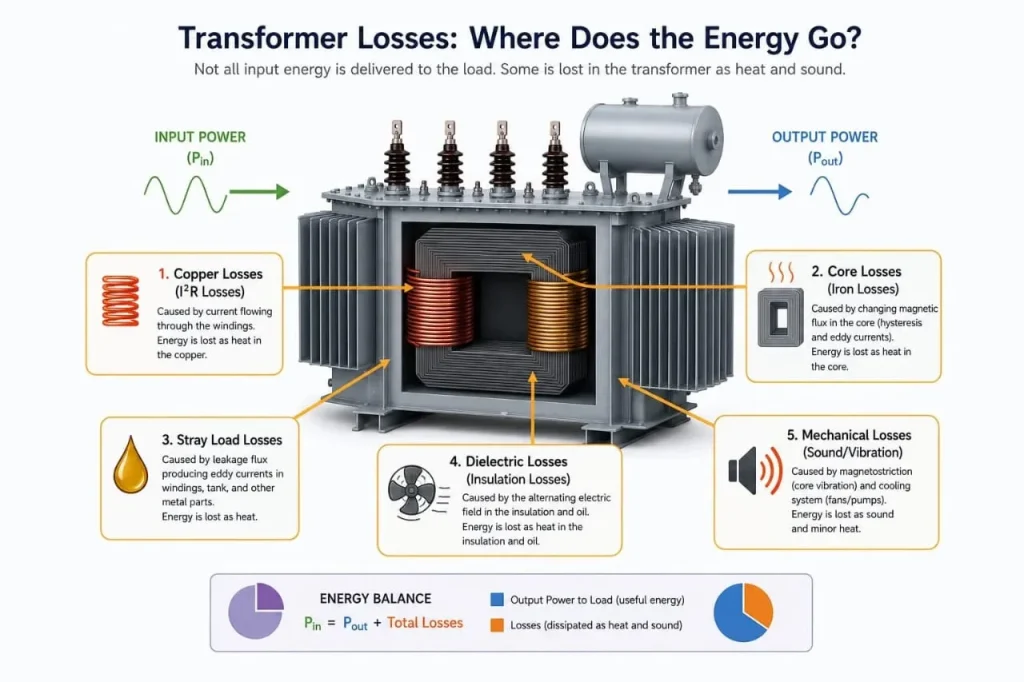
Core losses (iron losses):
Caused by hysteresis (repeatedly magnetizing and demagnetizing the iron core) and eddy currents (small circulating currents inside the core). Engineers reduce eddy current losses by using laminated core sheets instead of solid iron; each thin sheet is insulated from the next.
Copper losses (winding losses):
Heat generated by current flowing through the resistance of the copper windings (I²R losses). Higher current = more heat.
Well-designed power transformers achieve efficiencies of 95–99%, making them one of the most efficient electrical devices ever built.
Real-World Role in Power Distribution
If you want to see the bigger picture of how electricity travels from a power station to your home, this breakdown of how electrical power is generated and distributed gives good context on where transformers fit in the full chain.
For thermal power plants specifically, transformers play a critical role right at the output stage. You can read more about how a thermal power plant works and where step-up transformers come into the picture at the generation end.
Frequently Asked Questions
Can a transformer work on a DC supply?
No. Transformers require alternating current. DC produces a constant magnetic field, which doesn’t induce any voltage in the secondary winding. The only brief effect with DC happens when you switch it on or off because those transitions momentarily change the magnetic field.
Does a step-up transformer increase power?
No. A transformer cannot increase power that would violate the law of conservation of energy. A step-up transformer increases voltage while proportionally decreasing current. The total power (V × I) stays the same, minus small losses.
What is the difference between a power transformer and a current transformer?
A power transformer transfers electrical energy between circuits at different voltage levels. A current transformer is an instrument transformer used to measure or monitor high currents by scaling them down to safe values for meters and protection relays.
Why is the transformer core made of laminated iron?
Lamination reduces eddy current losses. Solid iron would allow large circulating currents to flow through the core, generating heat and wasting energy. Thin, insulated laminations interrupt those paths and keep losses low.
What happens if a transformer is overloaded?
Overloading causes excessive current in the windings, which generates heat beyond the transformer’s rated capacity. This can degrade insulation, accelerate aging, and, in severe cases, cause winding failure or fire. Most transformers have protective devices (fuses, relays, and temperature monitors) to shut them down before permanent damage occurs.
Conclusion
Understanding how a transformer works is more than textbook knowledge. It’s the foundation of every modern electrical system. From the giant step-up units at a power station to the small transformer inside your laptop charger, the principle is always the same: a changing magnetic field, two coils, and the physics of electromagnetic induction.
No moving parts. No complex electronics. Just copper, iron, and Faraday’s law doing a job that has kept the world powered for over a century.