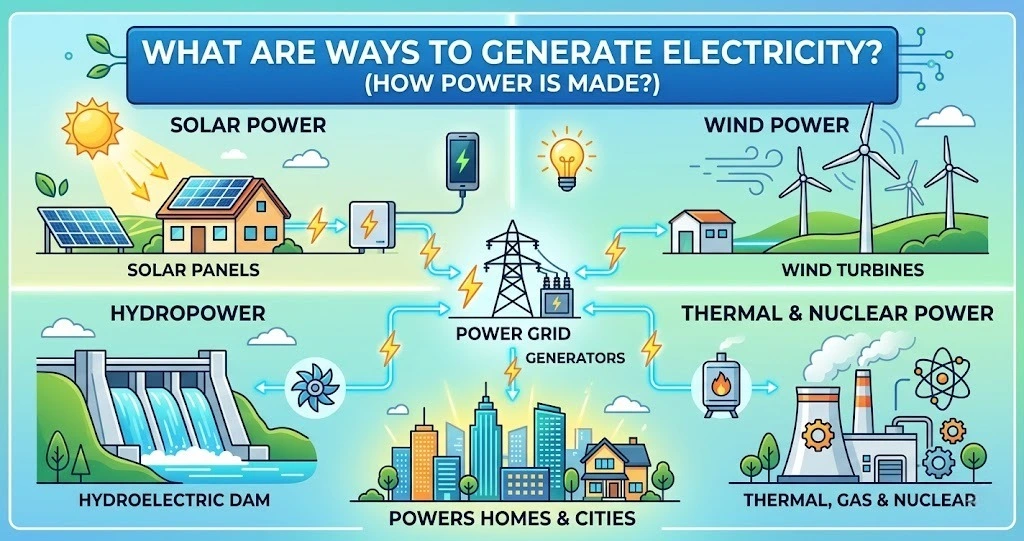
A generator is a device that converts mechanical energy into electrical energy. So, how does a generator work? It all comes down to one principle, electromagnetic induction, discovered by Michael Faraday in 1831. Inside a generator, an engine burns fuel to spin a rotor inside a set of copper wire coils. This spinning motion creates a magnetic field that induces an electric current in the coils, producing usable electricity.
What Is a Generator?
A generator is a machine that takes mechanical motion and turns it into usable electrical power. Think of it as the opposite of an electric motor. A motor takes electricity and produces motion. A generator takes motion and produces electricity.
At its core, every generator has two things: a magnetic field and a conductor (usually a coil of copper wire). When one moves relative to the other, electricity flows. That is the entire idea that everything else in the machine is to make that happen efficiently and safely. This is the basic working principle behind every generator, whether it’s a small portable unit or an industrial standby system.
How Does a Generator Produce Electricity?
So, how does an electric generator work to produce electricity? The process relies on a principle called electromagnetic induction, discovered by British scientist Michael Faraday in 1831. Faraday showed that when a conductor moves through a magnetic field, an electric current is induced in that conductor.
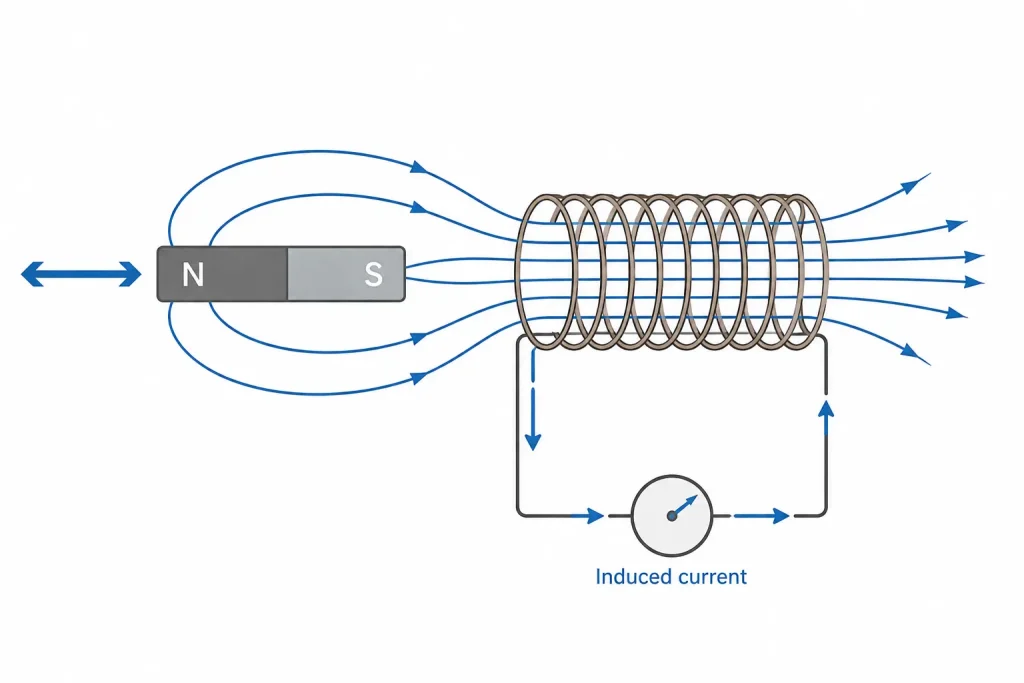
Inside a generator, a rotating shaft caused a component called the rotor, an electromagnet made by coiling wire around a metal core. This rotor spins inside the stator, which is a fixed set of copper wire coils. As the rotor turns, its magnetic field cuts through the stator windings and induces a voltage, which drives an electric current through the circuit.
The faster the rotation, the stronger the magnetic field, and the more turns in the coil, the higher the voltage produced.
In North America, generators produce AC (alternating current) at 60 Hz, meaning the current changes direction 60 times per second. This matches what your wall outlet delivers.
Main Parts of a Generator and What They Do
Every generator, portable or industrial, shares the same core components. Here is what each one does:
| Component | Function |
| Engine | Burns fuel (gasoline, diesel, propane, or natural gas) to create mechanical energy |
| Alternator | Contains the rotor and stator; the part that actually generates electricity |
| Voltage Regulator | Keeps output voltage stable so connected equipment is not damaged [4] |
| Fuel System | Stores and delivers fuel to the engine |
| Cooling System | Removes heat from the engine and alternator during operation |
| Exhaust System | Channels combustion gases safely away from the machine |
| Control Panel | Displays output voltage, frequency, and operational status |
| Battery | Powers the electric starter and is recharged by the alternator once running |
The alternator is the heart of the machine. By minimizing the gap between the rotor and stator, generators maximize the amount of electricity produced.
The voltage regulator is equally important. Without it, the raw voltage from the alternator fluctuates and can damage sensitive equipment. The regulator continuously monitors output and corrects any deviation.
Types of Generators and How Each One Works
Not all generators work the same way. The core principle is identical, but the design differences matter depending on your use case.
How Does a Portable Generator Work?
A portable generator uses a small internal combustion engine, typically running on gasoline, connected directly to an alternator. The engine runs at a fixed speed (usually 3,600 RPM in the US) to maintain the correct output frequency of 60 Hz.
You start it manually or with an electric starter, plug your appliances into its outlets, and it runs until the fuel runs out. Simple, affordable, and effective for temporary power needs. The trade-off is noise, fuel consumption, and the fact that you have to manage it yourself.
One important safety note: portable generators produce carbon monoxide. They should never run indoors or in enclosed spaces.
How Does an Inverter Generator Work?
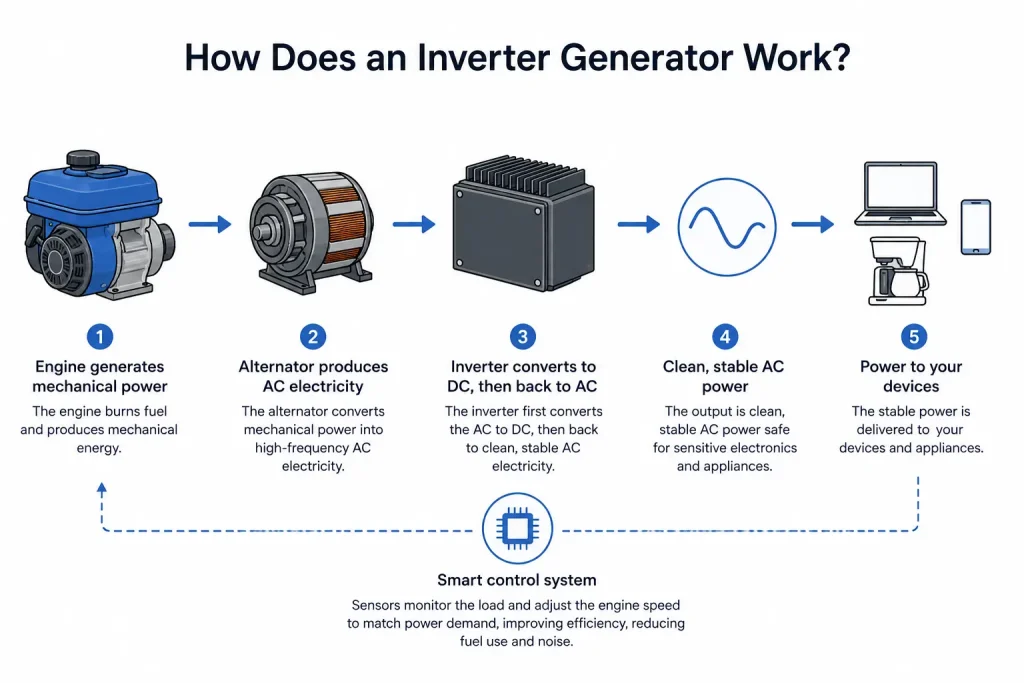
An inverter generator takes the process a step further. It generates raw AC power, converts it to DC through a rectifier, and then inverts it back to clean AC using a microprocessor-controlled circuit.
This extra step removes voltage fluctuations and irregularities, producing what engineers call “clean power” safe for laptops, phones, and other sensitive electronics.
The other advantage is fuel efficiency. Unlike a conventional generator that runs at full speed constantly, an inverter generator throttles its engine speed up or down based on how much power is actually needed. Less load means lower RPM, which means less fuel burned and less noise produced.
The trade-off is cost. Inverter generators are more expensive upfront than conventional portable units.
How Does a Standby (Home) Generator Work?
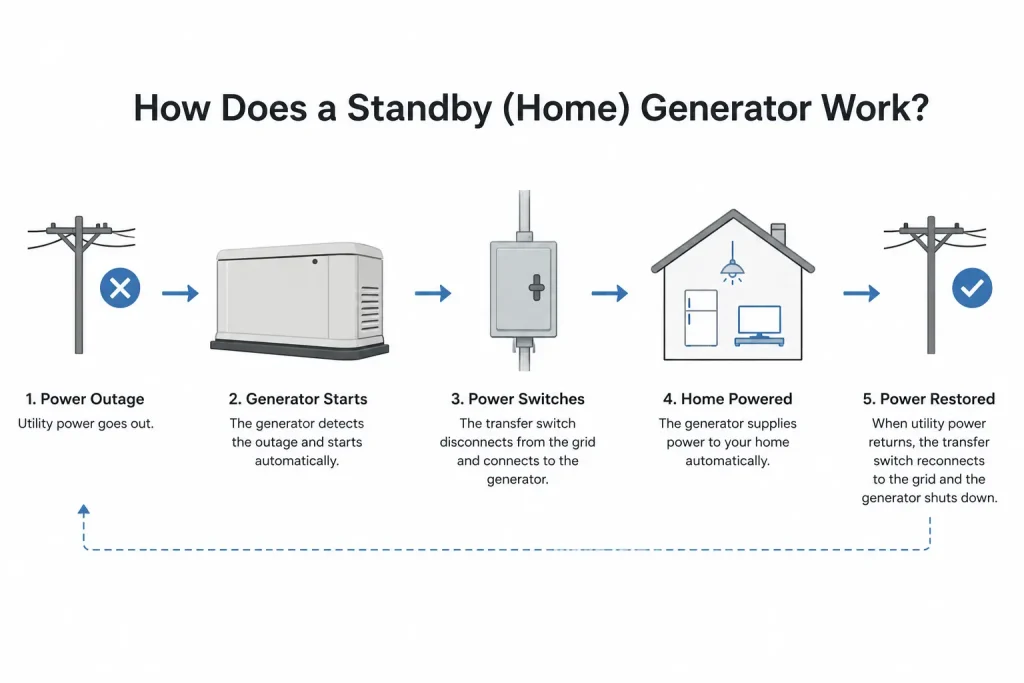
A standby generator is permanently installed outside your home, hardwired into your electrical panel through an Automatic Transfer Switch (ATS). It runs on natural gas or propane connected to your home’s existing supply, so there is no refueling involved.
The ATS constantly monitors utility power. The moment it detects an outage, it signals the generator to start. Within seconds, the generator is running, and the ATS switches your home’s power source from the grid to the generator.
When utility power returns, the ATS switches back automatically and shuts the generator down. You do not have to touch anything.
Standby generators are sized to run an entire home, heating, cooling, refrigeration, and medical equipment included. They are the closest thing to uninterrupted power you can have without living next to a power plant.
How Does a Generator Work Step by Step?
Here is the full process from fuel to electricity, in plain terms:
- Fuel enters the engine
Gasoline, diesel, propane, or natural gas combusts inside the engine cylinders.
- The engine produces mechanical rotation
Combustion drives the pistons, turning the crankshaft.
- The crankshaft spins the rotor
The rotor (an electromagnet) begins rotating inside the stator.
- The magnetic field cuts through the stator coils
This induces a voltage in the copper windings, per Faraday’s law of electromagnetic induction.
- The voltage regulator stabilizes the output
It corrects fluctuations to deliver consistent voltage.
- Electricity flows to connected devices
through the control panel outlets or, in standby systems, through the home’s electrical panel.
The entire chain from fuel combustion to usable electricity happens continuously as long as the engine runs.
Frequently Asked Questions
Can a generator work without electricity?
Yes. That is the point of a generator. It creates electricity from mechanical energy, not from the grid. The only electricity it needs initially is a small charge to power the electric starter, and even that is optional if you use a pull-start.
How does a generator work for a house?
A standby generator connects to your home’s electrical panel through an automatic transfer switch. When the grid goes down, the ATS detects the outage and switches the home’s power supply to the generator automatically, usually within 10 to 30 seconds.
How long can a generator run continuously?
Portable generators can typically run 8 to 12 hours on a full tank, depending on the load. Standby generators connected to a natural gas line can run indefinitely as long as the fuel supply continues, though manufacturers recommend periodic maintenance breaks for extended outages.
What is the difference between a generator and an inverter generator?
A conventional electric generator outputs AC power directly at a fixed engine speed. An inverter generator converts AC to DC and back to AC, producing cleaner power with lower harmonic distortion. Inverter generators are also quieter and more fuel-efficient because they adjust engine speed to match demand.
Research
Research for this article was supported by publications from the U.S. Energy Information Administration (EIA), the U.S. Department of Energy’s Pacific Northwest National Laboratory (PNNL), and Boston University’s Department of Physics (BU Physics).