How Does a Nuclear Reactor Work?
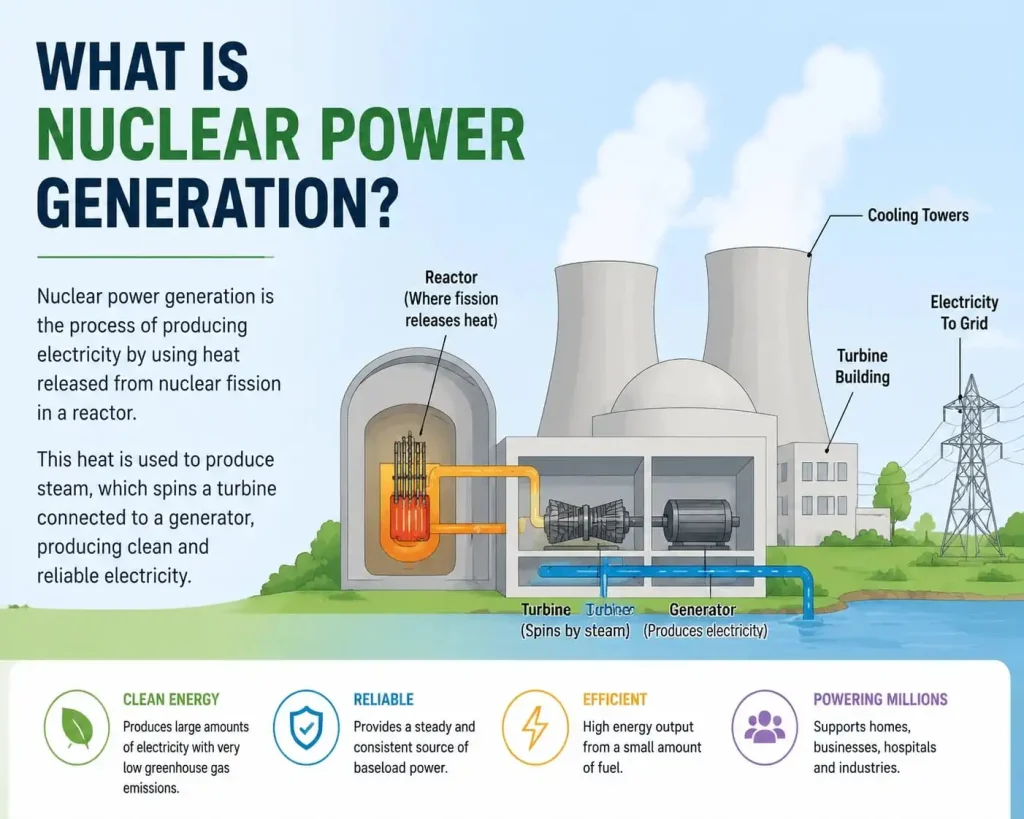
A nuclear reactor works step-by-step with the heat from splitting uranium atoms boiling water into steam, which spins a turbine and generates electricity. This process is called nuclear fission and is controlled inside a reactor core. The electricity produced is passed through a transformer and then to the national grid and into your home. This guide walks through every step, from the atom to the outlet. You’ll also see exactly how nuclear fission creates electricity and what every major component does.
Quick Answer: How a nuclear power plant works
- Uranium atoms are split in a process called fission, releasing huge heat
- That heat boils water into high-pressure steam
- Steam spins a turbine at thousands of revolutions per minute
- The turbine drives a generator that produces electricity via electromagnetic induction
- A transformer boosts the voltage for long-distance transmission to your home
What Is a Nuclear Power Plant, Really?
There are 94 operating reactors in the US and over 400 worldwide. The real question is not if it works. That’s how splitting something you can’t see under a microscope ends up lighting your house.
1. Nuclear Fission: Where the Energy Comes From
Nuclear fission is the process of splitting a heavy atom, releasing a massive amount of heat energy.
Here’s how it works:
A free neutron strikes a uranium-235 nucleus, causing it to become unstable and split into two smaller atoms. That split releases heat, radiation, and crucially, two or three more neutrons. Those neutrons go on to strike other uranium atoms, which split and release more neutrons, and so on. This self-sustaining process is called a chain reaction.
In short, nuclear fission is how a nuclear reactor makes electricity heat first, then everything else.
The energy released is extraordinary. Einstein’s E=mc² explains why even a tiny loss of mass during fission converts into an enormous amount of energy. One uranium fuel pellet roughly the size of a fingertip holds the energy equivalent of about one tonne of coal. At this stage, the output is purely heat, not electricity. Converting that heat into usable power is everything that follows.
What Is Uranium and Why Is It Used?
Uranium-235 is the fuel of choice because it is fissile. A slow-moving neutron can split it reliably and extraordinarily energy-densely. However, natural uranium ore contains only about 0.7% U-235; the rest is the heavier, non-fissile U-238. Before use in a reactor, the ore is processed and enriched to around 3–5% U-235, enough to sustain a controlled chain reaction, but nowhere near the 90%+ concentration required for a nuclear weapon. This enrichment step is why reactor fuel and weapons-grade material are fundamentally different things.
2. The Reactor Core: Anatomy of a Nuclear Reactor
Understanding the anatomy of a nuclear reactor starts here. The reactor core is where fission happens, and every component of a nuclear reactor plays a specific role. Consider it a carefully designed machine for controlling a chain reaction, speeding it up or slowing it down, and safely extracting heat.
Fuel Rods and Fuel Assemblies
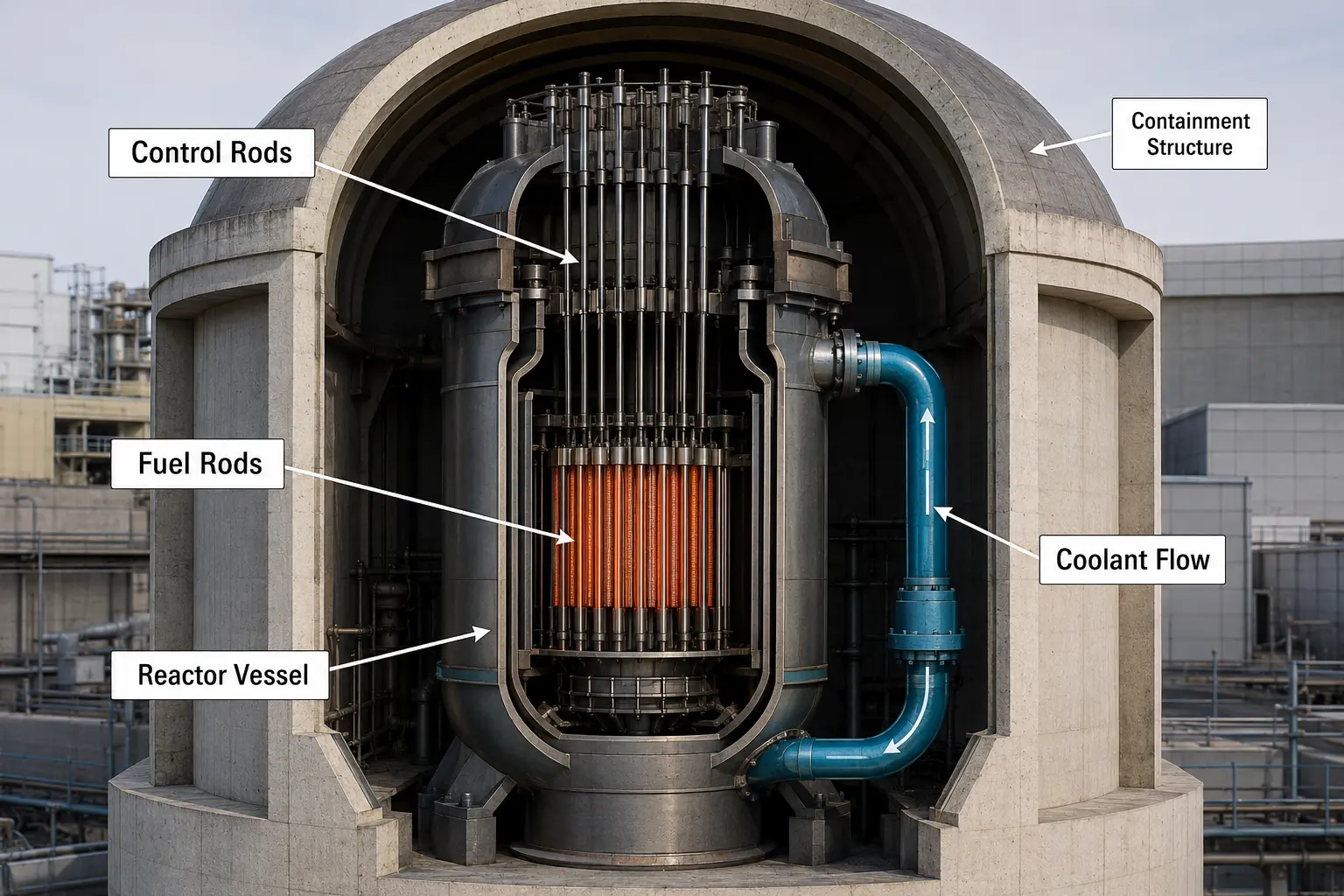
Uranium oxide is pressed into small ceramic pellets, each about the size of a pencil eraser. These pellets are stacked inside long, thin metal tubes, typically a zirconium alloy, to form fuel rods. Dozens of fuel rods are bundled into a fuel assembly, and hundreds of assemblies fill the reactor core. A typical core stands around 3–4 meters tall and holds tens of thousands of individual fuel rods, all spaced to allow water to flow between them.
How Control Rods Regulate the Reaction
Control rods are made from neutron-absorbing materials, commonly boron, silver, or hafnium. Control rods are positioned between the fuel assemblies and can be adjusted up or down by operators, similar to how a dimmer switch works.
The more you push them into the core, the more neutrons you absorb, and the slower the reaction becomes. Pull them out, and the reaction speeds up. In an emergency, control rods are dropped completely into the core, stopping the reaction almost instantly, a process called a SCRAM.
Coolant and Moderator (Water)
Water in a nuclear reactor performs two functions at once. As a coolant, it flows through the core, absorbing and transporting high temperatures. As a moderator, it slows down fast-moving neutrons to the lower speeds needed to maintain the chain reaction. Over 90% of reactors worldwide use water in this dual role, which is why nuclear plants are always built near large water sources like rivers, lakes, coastlines, or large spray ponds for inland sites
The Reactor Vessel and Containment Structure
The reactor vessel is a thick-walled steel container, up to 30 cm thick, which holds the entire core at high pressure. Surrounding it is the containment structure, a reinforced concrete building with walls typically over a meter thick, designed to prevent any release of radioactive material even under the most severe accident scenarios.
3. How a Nuclear Reactor Converts Heat to Steam
Once the reactor generates heat, the next job is converting it into steam. Hot water from the reactor transfers its energy to a steam system, and from here the process becomes almost identical to a conventional thermal power plant. At this point, the only thing that separates a nuclear plant from a coal plant is the heat source; nuclear simply substitutes a reactor for the furnace.
4. Reactor Types: PWR vs BWR
There are two dominant designs in commercial use today, and the difference lies in how steam reaches the turbine.
| Feature | PWR (Pressurised Water Reactor) | BWR (Boiling Water Reactor) |
| Where steam is made | Separate steam generator | Inside the reactor vessel |
| Number of water loops | Two (primary + secondary) | One |
| US share | ~65% | ~33% |
Pressurised Water Reactors (PWR)
In a PWR, water flowing through the reactor core is kept under roughly 155 times atmospheric pressure, so high it cannot boil even above 300°C. This superheated water is pumped to a separate steam generator, where it heats a completely independent second loop of water into steam. The two loops never mix, keeping radioactive water entirely isolated from the turbine side of the plant.
Boiling Water Reactors (BWR)
In a BWR, water is allowed to boil directly inside the reactor vessel. The resulting steam flows straight to the turbine, a simpler design with fewer components. The trade-off is that the turbine and pipework come into contact with slightly radioactive steam and require additional shielding and careful maintenance.
5. The Turbine, Generator, and Condenser
High-pressure steam exits the reactor system and blasts against the curved blades of a steam turbine, spinning the shaft at typically 1,500 to 3,000 revolutions per minute. The shaft connects directly to a generator. Inside the generator, the spinning shaft rotates a large electromagnet (the rotor) within a stationary coil of copper wire (the stator). As Faraday demonstrated in 1831, a moving magnetic field pushes electrons through a conductor, and the result is alternating current (AC) electricity.
After passing through the turbine, the spent steam enters a condenser, a large vessel where cool water flowing through pipes chills the steam back into liquid water. That water is then recirculated to be heated again.
The cool water that passes through the condenser absorbs the waste heat and has to go somewhere: either into a river, lake, or sea, or up through the familiar hourglass-shaped cooling towers. The steam rising from those towers is just water vapor, not radioactive, not smoke.
The generator in a nuclear plant is mechanically identical to the one in a coal or gas plant. Electromagnetic induction doesn’t care what’s spinning the shaft. Nuclear’s role is simply to provide an efficient, low-carbon way to do the spinning.
6. From the Plant to Your Home
The generator produces electricity at a relatively low voltage. A step-up transformer immediately boosts it to hundreds of thousands of volts for long-distance transmission. High voltage means lower energy loss over the lines. When it reaches your neighborhood, step-down transformers at local substations reduce the voltage to the safe levels that enter your home. That’s the journey from a split atom to a lit room.
Energy Transformations: The Full Chain
These are the energy transformations in a nuclear power plant from the binding energy locked inside uranium to the electricity that reaches your home.
| Stage | Transformation |
| 1 | Nuclear energy (binding energy in uranium) → Thermal energy (fission heat) |
| 2 | Thermal energy → Kinetic energy (high-pressure steam) |
| 3 | Kinetic energy → Mechanical energy (turbine rotation) |
| 4 | Mechanical energy → Electrical energy (generator induction) |
| 5 | Electrical energy → Grid via transformer |
Most nuclear plants convert 33–37% of their thermal energy into electricity (thermodynamic efficiency). This is a physical limit of all heat-based power generation, not unique to nuclear. The remaining heat is then discharged into cooling towers or a nearby water body.
What About Small Modular Reactors (SMRs)?
Traditional nuclear plants are large, expensive, and take over a decade to build. SMRs are a new direction, compact reactors (typically under 300 MW) that can be built in a fraction of the time in a factory. Because they operate with smaller cores and reduced decay heat, many SMR designs rely on passive safety systems, gravity, and natural convection rather than pumps and require less cooling water, opening up installation sites that large plants could never use. Several designs are in advanced development or early deployment in the US, UK, and Canada.
Quick Comparison: Nuclear vs Coal vs Wind
| Feature | Nuclear | Coal | Wind |
| Heat source | Uranium fission | Fossil fuel combustion | No heat—direct mechanical |
| CO₂ during operation | None | High | None |
| Energy per kg of fuel | Extremely high | Low | N/A |
| Capacity factor | ~90% | ~50% | ~30–40% |
Frequently Asked Questions
How does a nuclear power plant differ from a coal power plant?
Both use heat to boil water and spin a turbine-generator. This mechanical process is identical. The difference is the heat source: nuclear uses uranium fission; coal burns fossil fuel. Nuclear power produces no CO₂ during operation and generates far more energy per kilogram of fuel.
How long does nuclear fuel last in a reactor?
A typical fuel assembly stays in the reactor for 3–6 years before replacement. The uranium pellets are gradually depleted across multiple fuel cycles as U-235 is consumed and fission products accumulate.
What happens to nuclear waste?
Used fuel is stored first in deep cooling pools at the plant site. Once sufficiently cooled, typically after several years, it moves to dry cask storage in sealed steel and concrete containers. A year’s worth of electricity for one person generates roughly 5 grams of highly radioactive waste (World Nuclear Association).
How does a nuclear reactor shut down?
Control rods are fully inserted, absorbing neutrons and halting the chain reaction within seconds. However, the fuel continues to produce residual decay heat for hours or days afterward, which is why cooling must remain active even after shutdown.
Can a nuclear power plant explode like a nuclear bomb?
No, physics makes this impossible. A weapon requires uranium enriched above 90% U-235. Reactor fuel is enriched to only 3–5%. The geometry, enrichment level, and design of a reactor make a nuclear detonation physically impossible.
Research:
Research for this article was supported by publications from the U.S. Energy Information Administration (EIA), U.S. Department of Energy (DOE), International Renewable Energy Agency (IRENA), and Ember’s Global Electricity Review 2025.