Most of the world’s electricity is generated by burning something. That’s the honest starting point.
According to the International Energy Agency (IEA), thermal power plants generate over 60% of global electricity. Before renewables can fully take over, it helps to understand what they’re replacing and why it’s taking so long.
What Is a Thermal Power Plant?
A thermal power plant converts heat into electricity.
Fuel burns, heats water, turns it into steam, steam spins a turbine, and the turbine drives a generator, which produces electricity. That’s the full chain.
These plants are also called steam power plants. They run on a thermodynamic process called the Rankine Cycle, named after Scottish engineer William Rankine (1820–1872). Nuclear plants work the same way, just with a different heat source.
How Does a Thermal Power Plant Work?
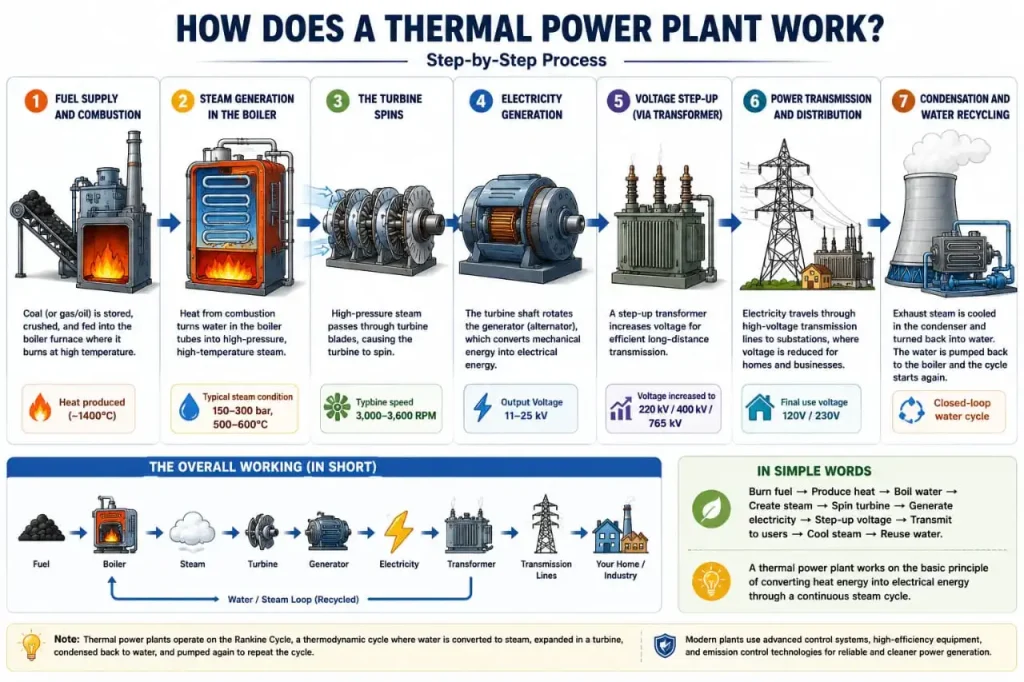
A thermal power plant works by burning fuel to heat water into high-pressure steam. That steam spins a turbine, which drives a generator that produces electricity. The steam is then cooled, condensed back into water, and recycled. This process is called the Rankine Cycle.
Why Do We Still Need Thermal Power Plants?
Solar panels exist. Wind turbines exist. So why are countries still burning coal and gas?
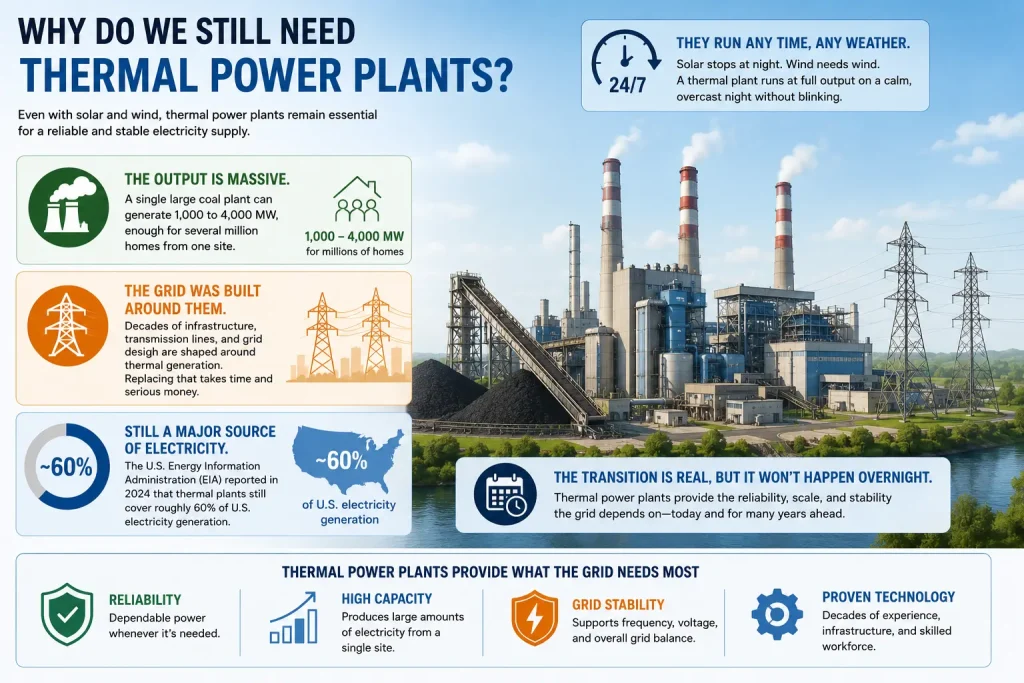
They run any time, any weather. Solar stops at night. Wind needs wind. A thermal plant runs at full output on a calm, overcast night without blinking.
The output is massive. A single large coal plant can generate 1,000 to 4,000 MW, enough for several million homes from one site.
The grid was built around them. Decades of infrastructure, transmission lines, and grid design are shaped around thermal generation. Replacing that takes time and serious money.
The U.S. Energy Information Administration (EIA) reported in 2024 that thermal plants still cover roughly 60% of U.S. electricity generation. The transition is real, but it won’t happen overnight.
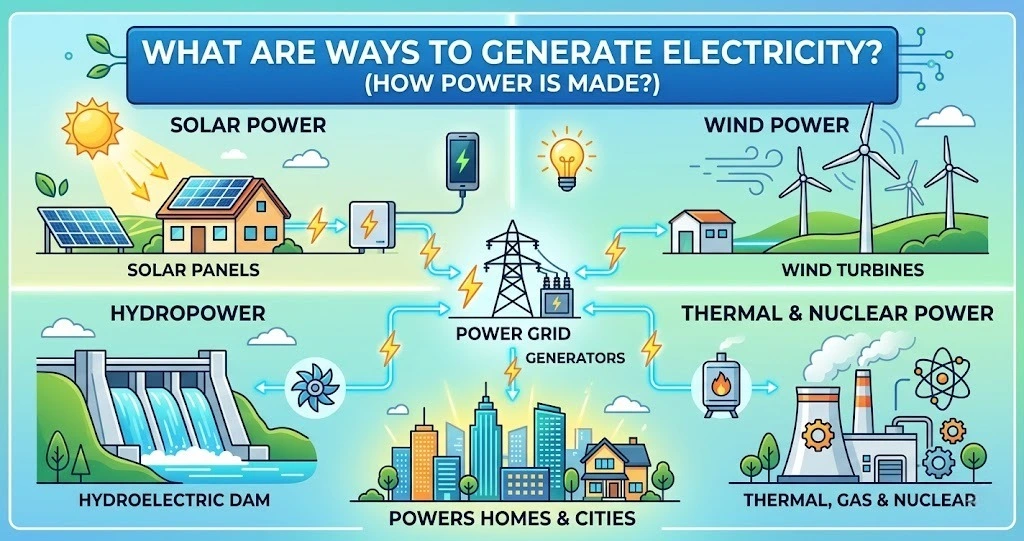
Thermal is one part of a much wider picture. Our article on ways to generate electricity breaks down how all major generation methods, like solar, wind, hydro, and thermal, compare in one place.
How Does a Thermal Power Plant Work?
- Fuel Burns in the Boiler
In coal plants, raw coal gets crushed into fine powder by a pulverizer. Fine powder burns faster and more completely than solid chunks. It gets blown into the boiler furnace, where it burns at temperatures above 1,400°C (2,550°F).
Gas plants skip the crushing. Natural gas feeds directly into a combustion chamber.
- Steam Is Produced
The furnace heats water running through steel tubes inside the boiler. This produces high-pressure steam at around 150–300 bar and 500–600°C.
That steam carries enormous energy, and that energy is what drives everything downstream.
- Steam Spins the Turbine
Steam hits the blades of a steam turbine at high velocity. The blades spin. The shaft they’re attached to spins with them.
Most plants use three turbine stages: High Pressure (HP), Intermediate Pressure (IP), and Low Pressure (LP). Each stage pulls more energy from the steam before it exits.
Turbines run at 3,000–3,600 RPM. That speed must stay consistent. It controls the frequency of the electricity being produced.
- The Generator Makes Electricity
The turbine shaft connects to an electrical generator. Spinning electromagnets inside copper coil windings create a changing magnetic field, which induces an electrical current.
This is electromagnetic induction, the principle Michael Faraday demonstrated in 1831. Still powering the world nearly 200 years later.
The generator outputs at 11–25 kV.
- Voltage Goes Up, Then Down
11–25 kV is too low for long-distance transmission. A step-up transformer raises it to 220 kV, 400 kV, or 765 kV. Higher voltage means less energy lost as heat along the lines.
At the destination, step-down transformers at substations reduce voltage to usable levels, 230V in most countries and 120V in the USA.
- Steam Condenses and Recycles
After the turbines, exhaust steam flows into a condenser. Cold water cools it back into liquid. That liquid gets pumped back to the boiler, and the cycle repeats.
Those large concrete towers at power plants release water vapor, not smoke. A common mix-up worth clearing once and for all.
Key Components at a Glance
| Component | What It Does |
| Boiler / Steam generator | Burns fuel, heats water to produce steam |
| Superheater | Pushes steam temperature higher before the turbine |
| Steam turbine | Converts steam pressure into shaft rotation |
| Generator / Alternator | Converts rotation into electrical energy |
| Condenser | Cools exhaust steam back into water |
| Step-up transformer | Raises voltage for efficient long-distance transmission |
| Electrostatic precipitator | Captures fly ash before it leaves the chimney |
| Flue gas desulfurization (FGD) | Removes sulfur dioxide from exhaust gases |
One failure in any of these components can take the whole plant offline. That’s why operation and maintenance is treated as seriously as the generation process itself.
Here it is, rewritten simply:
Types of Thermal Power Plants
Not all thermal plants work the same way. The fuel they use and how they’re built both affect how much electricity they produce from the same amount of fuel.
Coal-fired (subcritical)
The oldest and most common type. For every 100 units of energy in the coal, it produces around 33 to 37 units of electricity. The rest is lost as heat.
Coal-fired (supercritical)
A newer version of coal plants. Burns coal more efficiently and gets 42 to 45 units of electricity from the same 100 units of fuel. Less waste, less coal burned.
Natural Gas Open Cycle
Runs on gas and starts up fast. Mostly used when electricity demand suddenly goes up. Efficiency sits between 35 and 42%.
Natural Gas Combined Cycle (CCGT)
The smartest gas plant design. It generates power twice from the same gas. First through a gas turbine, then by using the leftover heat to make steam for a second turbine. Gets 55 to 62 units out of 100. Best efficiency of any thermal plant today.
Nuclear Thermal
Same steam and turbine process, but uranium replaces fuel. No burning, no smoke. Efficiency is similar to basic coal at 33 to 37%.
Biomass Thermal
Burns organic material like wood waste or crop leftovers. Least efficient at 25 to 35%, but counts as renewable energy in most countries.
Operation and Maintenance
Running a thermal plant isn’t a passive job. Operators manage load output in real time, monitor water chemistry to prevent corrosion, track fuel quality, and keep emissions within legal limits, all simultaneously.
Maintenance falls into three types:
Preventive (PM)
Scheduled on a fixed calendar. Lubrication, filter changes, instrument calibration, and bolt checks.
Predictive (PdM)
Uses vibration sensors, thermal cameras, and oil analysis to catch problems before they cause failures.
Corrective
Fixing what breaks. PM and PdM exist specifically to keep this type rare.
According to the Electric Power Research Institute (EPRI), poor maintenance causes 30–40% of all unplanned outages at thermal plants. Downtime at this scale costs millions per day, so predictive programs pay for themselves fast.
Modern plants run on Distributed Control Systems (DCS) and SCADA platforms, where operators monitor thousands of data points from a single control room.
Environmental Impact
Burning coal and oil releases CO₂, sulfur dioxide, nitrogen oxides, and fine dust into the air. CO₂ warms the atmosphere, sulfur dioxide causes acid rain, and fine particles cause breathing problems. Modern plants use dedicated equipment, precipitators, scrubbers, and catalytic reducers to cut most of these pollutants before they leave the chimney.
The one thing those systems don’t fully stop is CO₂. That’s where Carbon Capture and Storage (CCS) comes in. It catches CO₂ at the source and stores it underground instead of releasing it. The World Bank estimates CCS can reduce CO₂ emissions from thermal plants by 85–90%.
Cost is still the main barrier. The USA, Canada, and Norway are currently running pilot projects to make it more affordable at scale.
What Happens Inside a Thermal Power Plant Step by Step?
- Coal or gas burns in the boiler furnace at temperatures above 1,400°C
- Heat converts water in steel tubes into high-pressure steam (150–300 bar)
- Steam enters the High Pressure turbine stage, then IP, then LP, each extracting energy
- The turbine shaft spins at 3,000–3,600 RPM and drives the generator
- The generator produces electricity at 11–25 kV via electromagnetic induction
- A step-up transformer raises voltage to 220–765 kV for long-distance transmission
- Exhaust steam enters the condenser, cools into water, and the cycle repeats
Frequently Asked Questions:
What is a thermal power plant in simple words?
It burns fuel to make heat, uses heat to make steam, and uses steam to spin a turbine that generates electricity.
What fuel do thermal power plants use?
Mostly coal, natural gas, or oil. Some use uranium (nuclear), biomass, or municipal waste.
How efficient is a thermal power plant?
Standard coal: 33–37%. Supercritical coal: 42–45%. Combined cycle gas: up to 62%. The rest is lost as heat.
How long does a thermal power plant last?
Design life is 30–50 years. With proper maintenance, many run past 60.
What is the Rankine Cycle?
The operating cycle behind every steam thermal plant is heating water into steam, pushing it through a turbine, cooling it back to water, and repeating.
Conclusion
A thermal power plant converts energy to motion and then motion to electricity. The concept is over a century old. The scale, efficiency, and control systems behind modern plants are not.
It’s reliable, high-output, and still responsible for the majority of electricity on the planet. Emissions are a real concern, and the engineering community is working on real answers. CCS, cleaner fuels, and higher-efficiency designs.
For a full look at how thermal compares to solar, wind, and hydro, read our guide on ways to generate electricity.