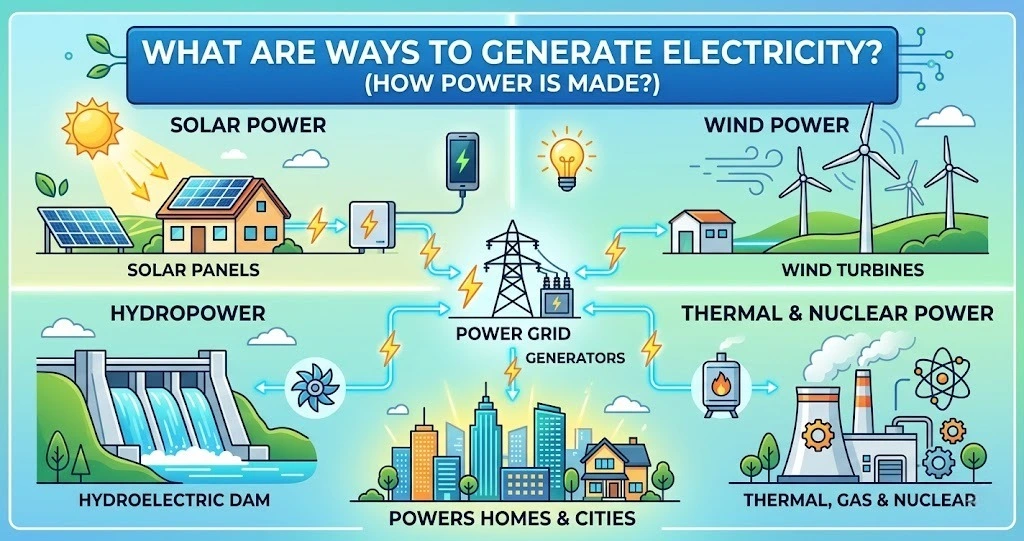
A solar panel is a flat device made up of small blue or black square cells that convert sunlight into electricity. If you searched for “what is a solar panel” hoping for an explanation that breaks away from the traditional textbook style, then the fundamental concept can be summed up in a single sentence, and the technical explanation isn’t very long either.
Once you understand how its components are interconnected, you will appreciate this perspective even more. As it actually explains why a solar panel on your neighbor’s roof continues to function even when the sky is overcast.
Key Takeaways
- A solar panel is a device made of connected photovoltaic (PV) cells that converts sunlight directly into electricity.
- A single cell is small and weak. Wiring dozens together into a panel and panels into an array is what makes solar power practical.
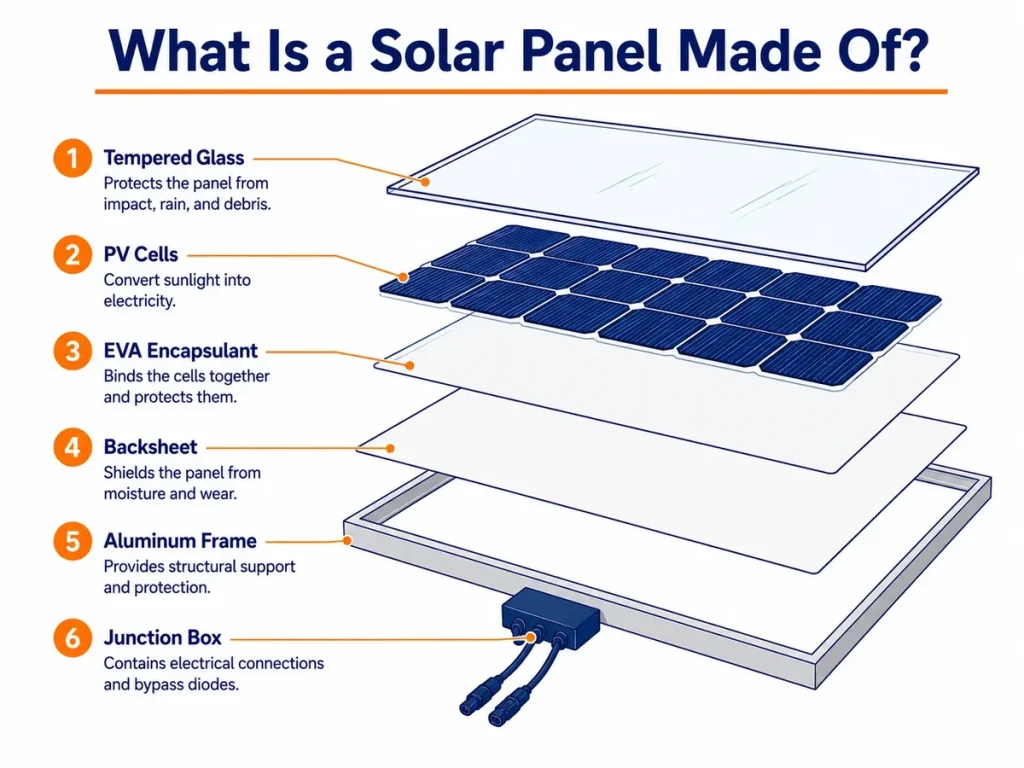
- A typical panel is built from six parts: PV cells, tempered glass, an EVA layer, a back sheet, an aluminum frame, and a junction box.
- Panels lose a small amount of output each year. According to NREL, the average rate of this degradation is approximately 0.5% annually; consequently, most panels continue to perform well even after their 25-year warranty period has expired.
- A solar panel generates only direct current (DC). An inverter is required to convert it into alternating current (AC), which is what your home actually uses.
This article explains what a solar panel is, what is inside it, and how it converts sunlight into usable energy. You’ll also see what materials solar panels are primarily made of and where and how this component fits into a larger solar panel system.
What Is a Solar Panel?
A solar panel is a device that converts sunlight into electricity using photovoltaic (PV) cells wired together and sealed inside a protective casing. The word “photovoltaic” just means “light to electricity,” which is a fairly honest name for a technology that does exactly what it says.
This is the working solar panel definition most engineers use, and it holds up whether you’re talking about the panel on a garden light or the ones covering a football-field-sized solar farm. The size changes. The principle doesn’t.
How Many Cells Are in One Panel?
Each panel contains dozens of individual solar cells. No single cell produces much electricity on its own, similar to how one domino doesn’t do much until you line up a hundred of them. Connect enough cells in the right pattern, though, and you get a panel that can meaningfully power a home.
Residential panels usually pack in somewhere between 60 and 72 cells, wired in rows and sealed under a single sheet of glass. That number isn’t random. It’s a balance between panel size, weight, and how much voltage the finished panel needs to output for a typical home system.
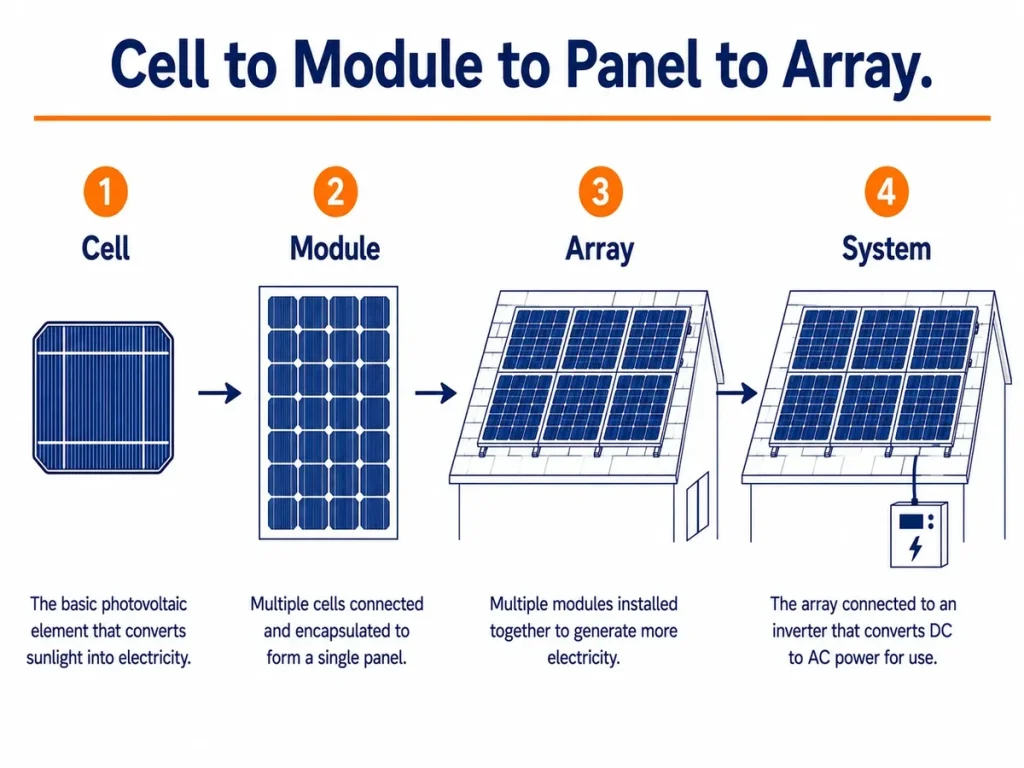
The Cell, Module, Panel, and Array Hierarchy
People throw around “cell,” “module,” “panel,” and “array” like they’re interchangeable. They’re related, but they’re not the same thing, and mixing them up is where a lot of the confusion around solar technology starts.
| Term | What It Is |
| Cell | A single photovoltaic unit, usually a few inches wide. Produces a small amount of electricity on its own. |
| Module (Panel) | Dozens of cells wired together and sealed under glass. This is what people usually mean by “solar panel.” |
| Array | Multiple panels connected together, mounted on a roof or field. |
| System | The array plus the inverter, wiring, and other equipment needed to actually deliver usable power. |
Think of it like a pack of batteries. One battery is a cell. A few batteries taped together in a device is a module. A shelf full of those devices is an array. The system is everything, including the device that lets you actually use the power.
What Is a Solar Panel Made of?
If you have ever wondered what a solar panel is made of, the honest answer is “not as extraordinary as you might think.” The majority of the panel’s weight consists of ordinary glass, aluminum, and plastic. Its clever feature is a thin layer of silicone in the middle.
| Component | Material | Function |
| PV Cells | Silicon | Converts sunlight into electricity |
| Front Glass | Tempered glass, 3 to 4mm thick | Protects the cells and lets light through |
| Encapsulant | EVA (ethylene vinyl acetate) film | Bonds the layers together and seals out moisture |
| Back sheet | Polymer (PVF or PET) | Insulates and protects the rear of the panel |
| Frame | Aluminum | Holds everything rigid and provides a mounting point |
| Junction Box | Weather-resistant plastic | Houses the wiring connections and bypass diodes |
Six parts, one job. Sunlight goes in, electricity comes out, and everything else exists to protect that process for a couple of decades.
Which Part Wears Out First?
Here’s the part most articles skip. A solar panel doesn’t fail all at once. It fades slowly, and the pieces holding it together age at different speeds.
The Cells Barely Age
The silicon cells themselves are remarkably durable. According to NREL, the median degradation rate for a solar panel is about 0.5% per year. That means a panel producing 400 watts on day one is still producing roughly 355 watts after 25 years, not zero. Most manufacturer warranties are built around this exact number, guaranteeing 20 to 25 years of usable output.
The Real Culprits: Junction Box and Back sheet
The parts more likely to need attention first aren’t the cells. It’s the junction box seals and the back sheet, both of which sit directly exposed to heat, UV light, and moisture for years on end. A cracked back sheet or a failed seal won’t stop a panel from working immediately, but it’s usually the first thing an inspector flags, long before the cells themselves show real wear.
How Does a Solar Panel Work?
The short answer is physics, not magic, and it happens in two stages.
The Photovoltaic Effect
So, what do solar panels do, mechanically speaking? They run on something called the photovoltaic effect, and it’s genuinely one of the more elegant tricks in physics.
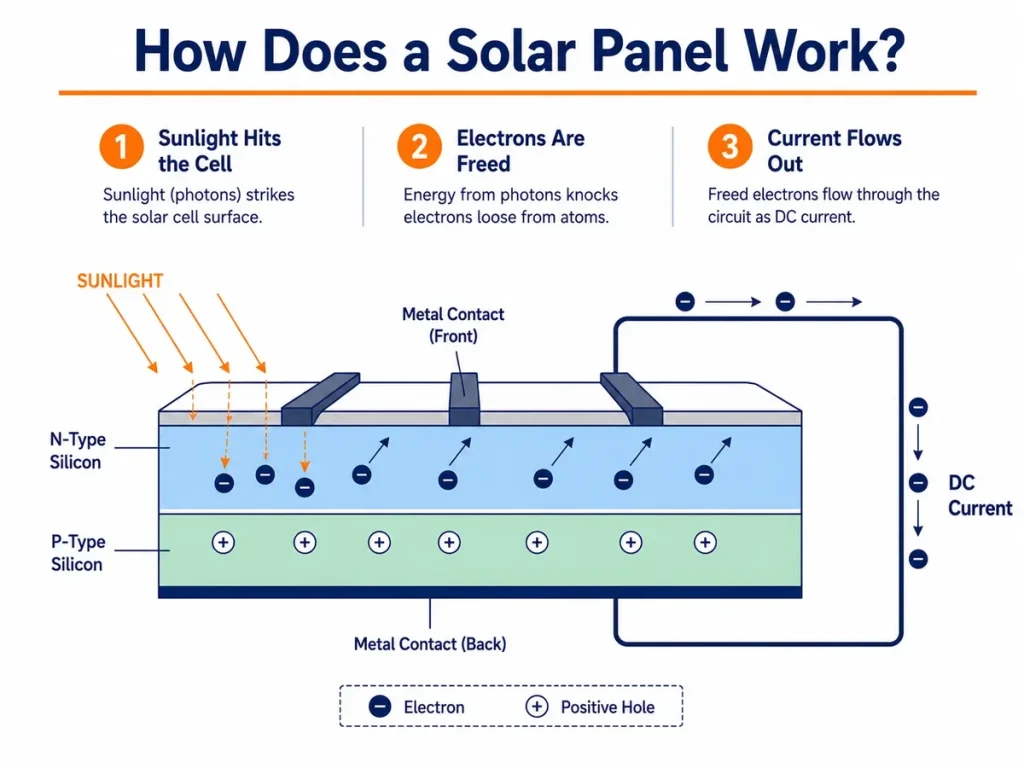
Sunlight is made of photons, tiny packets of energy. When photons hit a solar cell, they knock electrons loose from the silicon atoms inside it. Those freed electrons get pushed toward the surface of the cell by an internal electric field, and metal contacts on the cell collect them as they move.
From Electrons to Electric Current
The flow of electrons in a single direction is what constitutes electric current. That’s how solar panels generate electricity can be explained in a single sentence: sunlight enters, and moving electrons are released.
.
There’s a catch. The current a panel produces is direct current (DC), the same type of electricity a battery makes. Most homes run on alternating current (AC). The panel itself can’t fix that mismatch. Something else in the system has to.
What Is a Solar Panel System?
A panel is only one piece of a bigger picture, and the rest of that picture matters just as much.
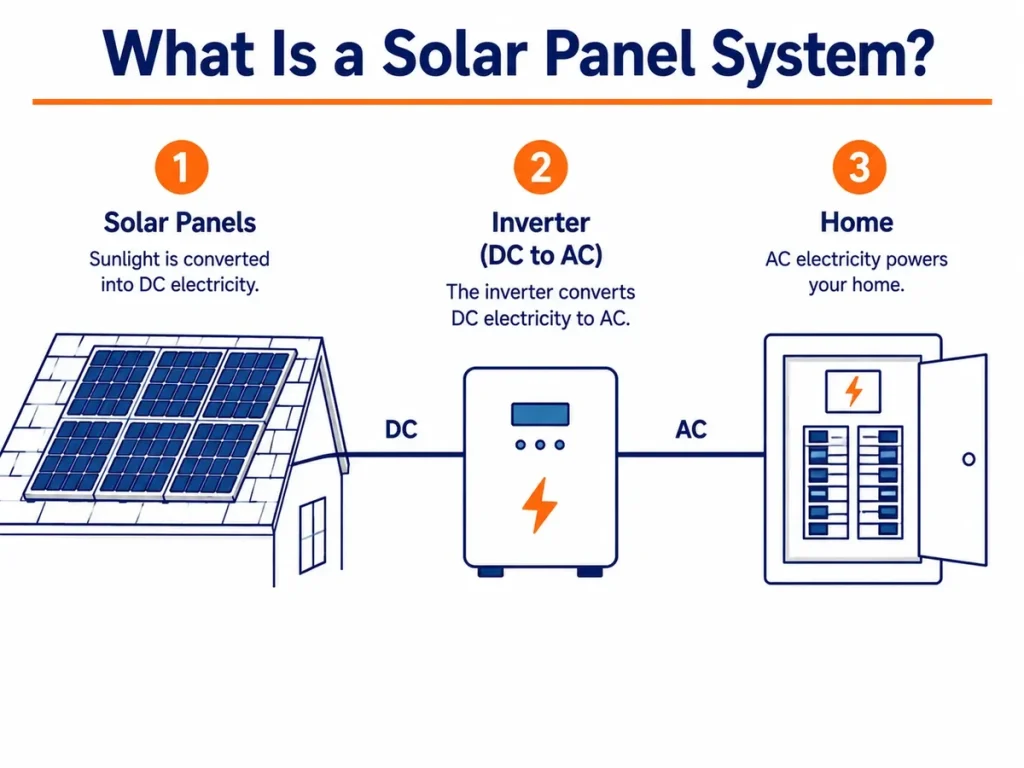
What’s Included in a Basic System
A single panel bolted to a roof doesn’t power a house by itself. It needs help, and that help is the rest of the solar panel system.
A basic setup includes the panels (or array), an inverter, and the wiring connecting them to your electrical panel. The inverter’s job is to take the DC electricity coming out of the panels and convert it into the AC electricity your outlets actually use. Some systems also include a battery, which stores extra power for use after the sun goes down.
Panel Type Still Matters
This is also where panel type starts to matter. If you’re comparing options for an actual installation, our guide on the different types of solar panels breaks down how monocrystalline, polycrystalline, and thin-film panels differ in cost and performance.
The System Works Together, or Not at All
None of this equipment works in isolation. A high-efficiency panel paired with an undersized inverter will still underperform, and a great inverter can’t fix a panel that’s shaded half the day. The system, not any single part, determines what actually shows up on your electricity bill.
So next time someone asks what is solar panel technology is actually doing on a roof, the short answer is converting light to electricity, then handing that electricity off to equipment built to make it usable.
Frequently Asked Questions
What is a solar panel and how does it work?
A solar panel is a device made of photovoltaic cells that converts sunlight into electricity. It works by using sunlight to knock electrons loose inside the cells, creating a flow of direct current that an inverter later converts into usable AC power.
What are the three types of solar panels?
The three main types are monocrystalline, polycrystalline, and thin-film. They differ mainly in efficiency, cost, and appearance. Our guide to the main types of solar panels covers which one fits different roof types.
Can a solar panel work without sun?
A solar panel needs light to produce electricity, but that light doesn’t have to be direct sunlight. Panels still generate power on cloudy days, just at a reduced output, since diffuse light still contains photons.
Do solar panels generate AC?
No. Solar panels only produce direct current (DC) electricity. An inverter is required to convert that DC output into the alternating current (AC) that homes and the power grid use.
Research
Research for this article was supported by publications from the U.S. Energy Information Administration (EIA), the U.S. Department of Energy’s Solar Energy Technologies Office (DOE), and the National Renewable Energy Laboratory (NREL).