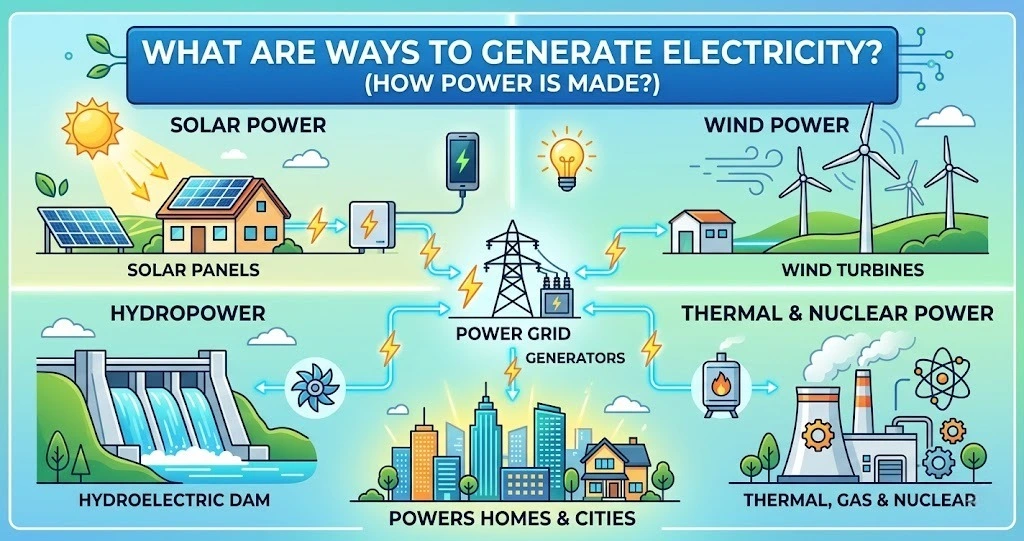
How is AC electricity made? A magnet rotates inside a coil of copper wire, and this rotational motion pushes electrons back and forth rather than in a single, constant direction. That reversing push is what makes the current “alternating,” and it’s the same basic trick every power plant on Earth relies on.
Every outlet in your home is on the receiving end of that spinning magnet, whether it’s a coal furnace, a nuclear reactor, or plain wind doing the spinning. Somewhere between the plant and your wall socket, someone built a much bigger, much angrier version of a bicycle dynamo and pointed it straight at your house.
This guide explains the exact process of how it all happens, from the alternator inside the power plant to the ‘sine wave’ currently present in your electrical socket.
Key Takeaways
- AC electricity comes from electromagnetic inductions, specifically a magnet rotating inside a coil of wire.
- The machine that does this is called an alternator, or AC generator.
- One full turn of the magnet produces one full cycle of the sine wave.
- The US power grid runs at 60 Hz. That means the current reverses direction 60 times every second.
- Transformers raise voltage for long-distance transmission, then lower it again before your home uses it.
What Is AC Electricity?
AC stands for alternating current. Unlike DC electricity, which flows in one steady direction, AC electricity reverses direction on a fixed, repeating cycle. That back-and-forth pattern is literally what “alternating” describes.
DC comes from sources like batteries and solar panels, where electrons move one way and stay that way. AC comes from generators, and it’s what powers your home because it can be transmitted across a country far more efficiently than DC can. We cover that comparison in full in our guide to how electricity works, so we won’t repeat the whole thing here. What matters for this guide is the generation side: how do you actually get a current to flip direction on purpose?
How Is AC Electricity Generated? (The Core Mechanism)
Electromagnetic Induction: In Simple Terms
The whole process rests on one discovery. In 1831, Michael Faraday found that moving a magnet near a wire induces a voltage in that wire, no physical contact required. Move the magnet, and electrons in the wire get pushed. Stop moving it, and they stop.
That’s it. That’s the entire secret behind how AC electricity is generated. Everything else is just a bigger, more organized version of that same idea.
Inside an Alternator: Rotor, Stator, and Poles
The machine that turns this principle into usable power is called an alternator, sometimes just called an AC generator. It has three main parts worth knowing:
- Rotor: The spinning part, usually a magnet or an electromagnet mounted on a shaft.
- Stator: The stationary ring of copper coils surrounding the rotor.
- Poles: The north and south magnetic ends on the rotor that actually do the inducing.
Spin the rotor, and its magnetic poles sweep past the stator coils one after another. Each pass induces a voltage. That’s how a generator makes AC electricity, mechanically speaking, and it hasn’t changed much since Faraday’s era.
Why Rotating Produces AC (Not DC)
Here’s the part most explanations skip. As a north pole sweeps past a coil, it induces current flowing one way. A half-turn later, the south pole sweeps past the same coil and induces current flowing the opposite way. That flip happens every single rotation, automatically, without any switch or circuit doing the deciding.
That flip is the entire reason the output is alternating current rather than direct current. A generator built to rotate simply cannot help producing AC. If you want DC out of a spinning machine, you need extra hardware, called a commutator or a rectifier, to chop that alternating signal back into one direction. Nature gives you AC for free; DC takes extra effort.
How Do AC Sine Waves and Frequency Work?
One full rotation of the rotor equals one full cycle of the sine wave, the classic S-shaped curve you’d see on an oscilloscope. The voltage climbs, peaks, drops back through zero, dips to a negative peak, and returns, once per rotation.
Frequency just measures how many of those cycles happen every second. In the US, the grid is standardized at 60 Hz, meaning the current reverses direction 60 times per second, a standard confirmed by California’s Public Utilities Commission and used across the entire domestic grid.
That frequency isn’t arbitrary. It’s set by how fast the rotor spins and how many magnetic poles it has, following a fixed relationship: Frequency = (Poles × RPM) ÷ 120.
| Number of Poles | Rotor Speed (RPM) | Frequency Produced |
| 2 | 3,600 | 60 Hz |
| 4 | 1,800 | 60 Hz |
| 6 | 1,200 | 60 Hz |
| 8 | 900 | 60 Hz |
This is why a nuclear plant’s turbine and a hydro dam’s turbine can spin at completely different speeds and both still hand the grid a clean 60 Hz. Add more poles, and the rotor can spin slower while still landing on the same frequency. Engineers pick the pole count to match whatever’s turning the shaft.
How Is AC Electricity Produced and Delivered?
Once the alternator has done its job, the electricity still has a long trip ahead of it. Here’s the full chain, from spinning shaft to your kitchen outlet.
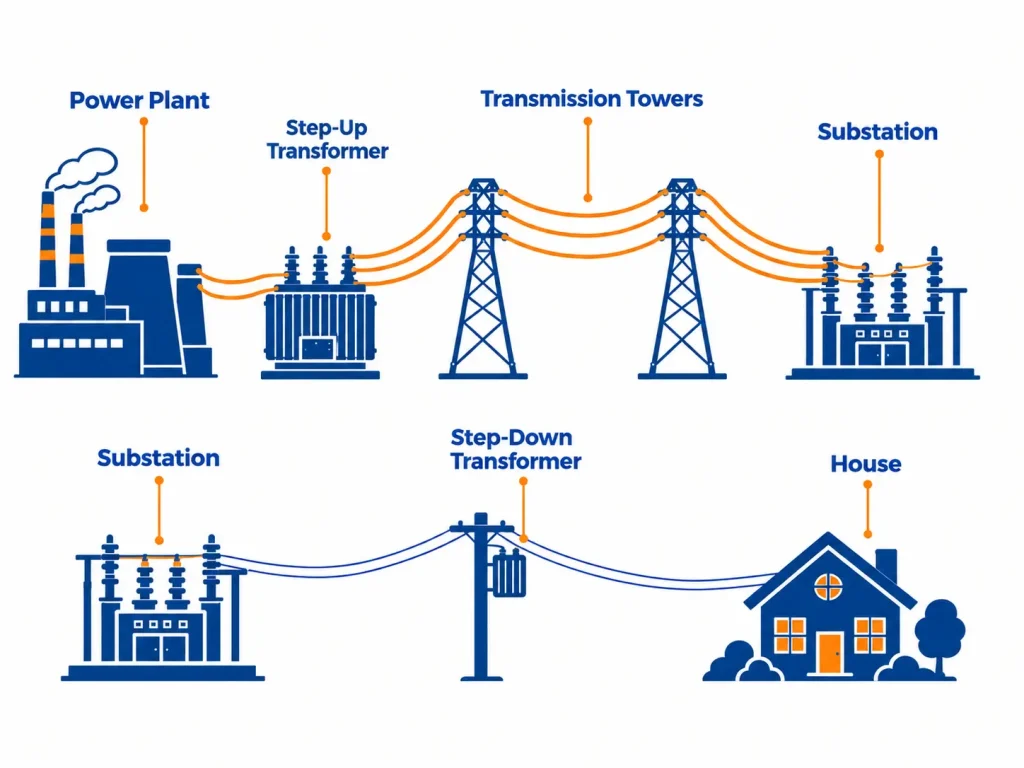
- A turbine spins the alternator’s rotor:
It is driven by steam, falling water, or wind.
- The spinning magnetic field induces alternating voltage in the stator’s copper coils:
This is the moment AC electricity is technically “made.”
- A step-up transformer raises that voltage:
It often climbs to somewhere between 115,000 and 765,000 volts before it leaves the plant.
- High-voltage AC travels the transmission lines:
Higher voltage means lower current, and lower current means less energy lost as heat over long distances.
- A step-down transformer at a substation lowers the voltage:
This prepares it for local distribution.
- A final transformer near your home steps it down to 120/240 volts:
This is the standard household level, ready for your outlet.
That step-up-then-step-down pattern is only practical because of transformers, which raise voltage for transmission and lower it again before it reaches you.
The turbine at step one can be spun by wildly different sources, burning fuel to make steam, a river, or plain wind, but that choice changes nothing about the alternator’s job. Whatever spins the rotor, the AC it produces works the same way.
Why Is AC Used Instead of DC for This Job?
Short answer: transformers only work on AC. Because AC’s voltage constantly rises and falls, a transformer can use magnetic induction to step that voltage up or down with very little energy lost in the process. DC doesn’t naturally offer that same trick, which is exactly why devices need an inverter whenever they need to convert stored DC power, such as from a battery or solar panel, back into the AC your household appliances expect.
Frequently Asked Questions
How does AC power work in a home?
By the time AC power reaches your home, transformers have already stepped it down to 120/240 volts. It still reverses direction 60 times per second, but at a voltage safe enough to run household appliances.
How Does a Simple AC Generator Work?
A simple AC generator, or alternator, spins a magnet inside a coil of copper wire. As the magnet’s poles sweep past the coil, they induce a voltage that reverses direction with every half turn, producing alternating current.
What is single-phase and three-phase AC electricity?
Single-phase AC uses one alternating waveform and powers most homes. Three-phase AC uses three waveforms offset from each other, delivering smoother, more constant power, which is why it’s standard for factories and heavy industrial equipment rather than houses.
What does AC electricity mean?
AC electricity means power delivered as a repeating wave instead of a steady flow, which is what allows it to travel efficiently across long distances.
Research
The 60 Hz grid frequency standard and US transmission voltage ranges cited in this guide are confirmed by the California Public Utilities Commission’s electric transmission fact sheet. Background on electricity generation and delivery in the US is available through the U.S. Energy Information Administration.