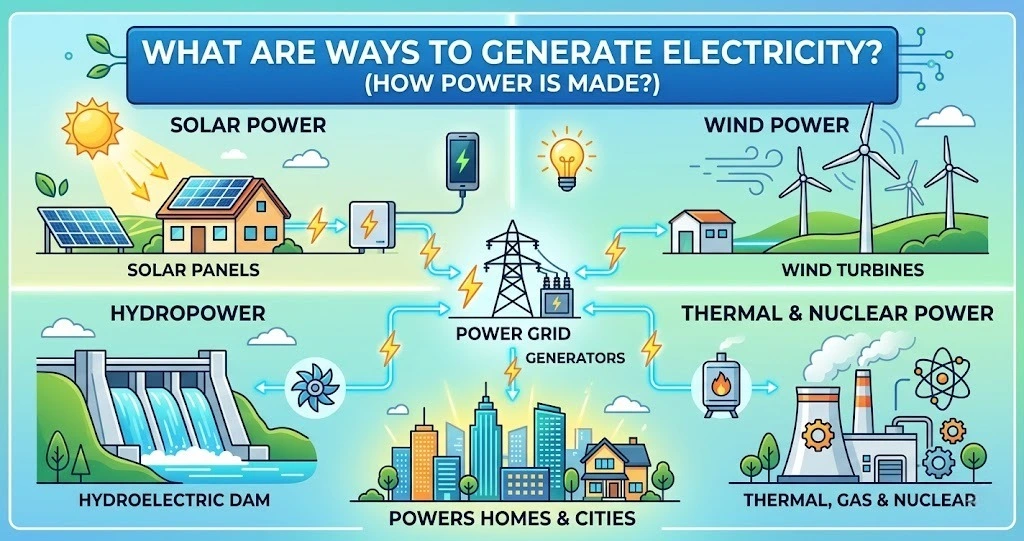
If you press the light switch during a power outage, nothing happens. Plug this same lamp into a battery-powered inverter, and it lights up immediately. That small trick is the whole job of an inverter, and once you see how it pulls it off, the mystery disappears fast.
So how does an inverter work? In short, it takes direct current (DC) from a battery or solar panel and converts it into alternating current (AC) to supply electricity to your home. This is achieved not through magic, but through a process of rapid switching, and the process breaks down into a few clear and repeatable steps
This guide provides a complete explanation of how an inverter works in simple terms, starting from when DC power comes in to when clean AC power flows out. It also highlights the key components and their importance. By the end, you’ll be able to explain the whole process to anyone who asks, without reaching for a textbook.
What Happens Inside an Inverter?
Here’s the short version of how an inverter works before we get into the details. An inverter receives stable DC power, then uses electronic switches to chop that power into rapid pulses. Those pulses get reshaped into a wave that mimics AC electricity, and a transformer boosts the voltage to a usable level.
Think of it like a relay race. The DC power is the baton, the switches pass it back and forth at speed, and the transformer gives it the final push across the finish line as usable household electricity. If you want to know how inverters work at a fundamental level, then this process of ‘switching and shaping’ provides the complete answer. Everything else is just refinement of that same idea.
How an Inverter Converts DC to AC (Step-by-Step)
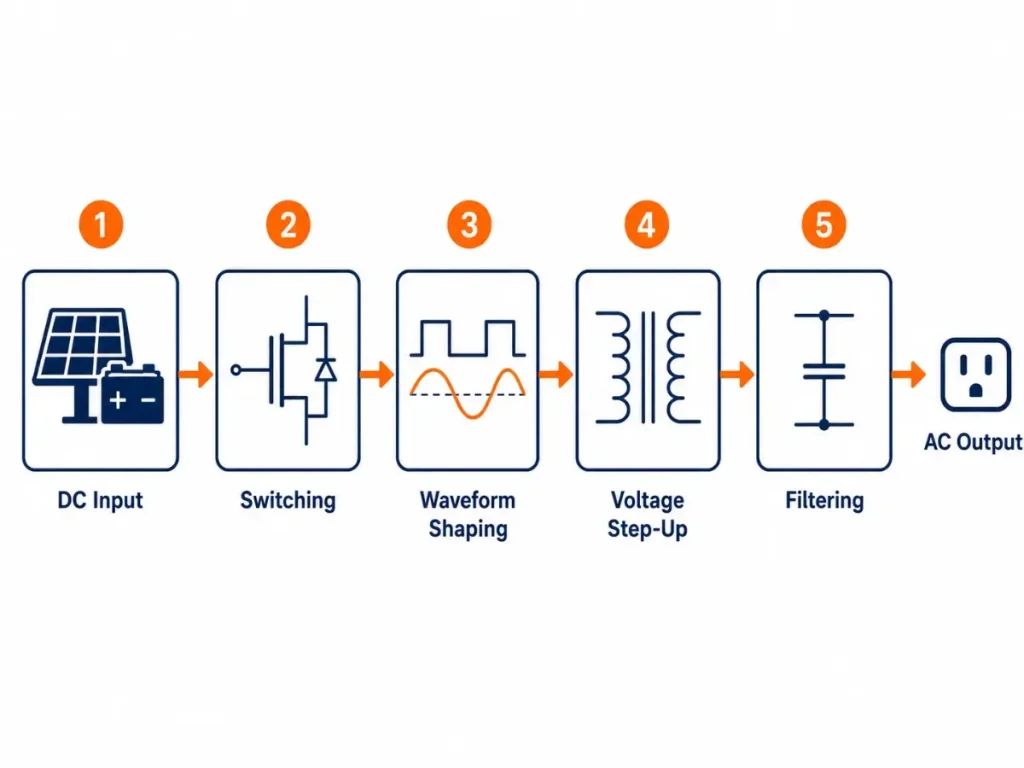
To understand how an inverter works, it is useful to consider the five stages involved in the process of converting DC power into AC power.
1. DC Power Input
The process starts with a steady DC source. This could be a car battery, a bank of solar panels, or a portable power station. The voltage is usually low, often 12V, 24V, or 48V, and it flows in one constant direction, unlike the back-and-forth current your appliances expect.
2. Electronic Switching
Inside the inverter sit semiconductor switches called transistors, often IGBTs or MOSFETs. These switches turn the DC current on and off at high speed, sometimes thousands of times per second, and this is really the heart of how an inverter works at the circuit level. By flipping the current’s direction in a controlled pattern, the inverter starts to imitate the back-and-forth behavior of AC.
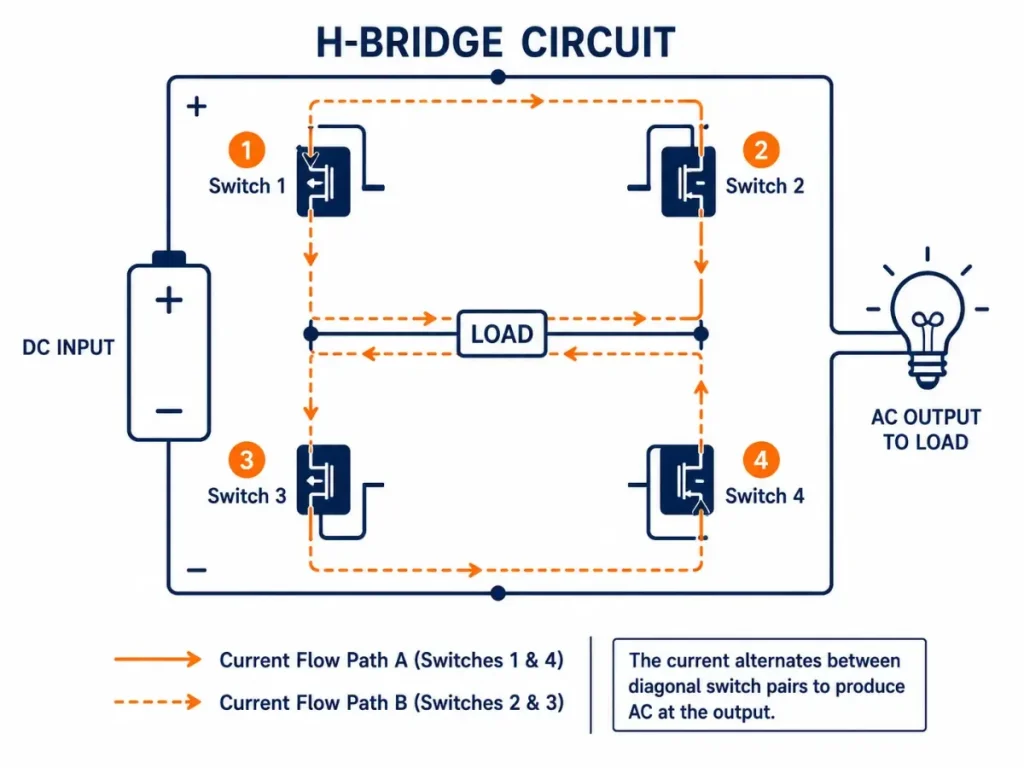
3. Shaping the Waveform
Raw switching alone produces a rough, square-shaped wave, not the smooth curve your appliances expect. To fix this, the inverter uses a technique called pulse width modulation. It varies the width of each electrical pulse so the average output traces something much closer to a real sine wave, the same shape your utility company delivers to the grid.
4. Voltage Step-Up
A 12V battery can’t run a refrigerator on its own, no matter how badly it wants to. So, the inverter passes the pulsed signal through a transformer, which steps the voltage up to 120V or 230V depending on the region. This is the same step that turns a trickle of battery power into something your wall outlets would actually recognize.
5. Filtering the Output
The last stage smooths out the remaining rough edges. Capacitors and inductors filter high-frequency noise from the signal, leaving a cleaner wave that closely resembles standard grid electricity. At this point, the inverter has finished its job, and usable AC power flows out to whatever you’ve plugged in, whether that’s a laptop charger or a full kitchen fridge.
The Inverter Process at a Glance
Here’s how power inverters work when you compress the whole five-stage sequence into one quick reference table.
| Step | What Happens |
| DC Input | A Battery or solar panel supplies steady direct current |
| Switching | Transistors rapidly flip the current on and off |
| Waveform Shaping | Pulse width modulation approximates a sine wave |
| Voltage Step-Up | A transformer raises voltage to household levels |
| Filtering | Capacitors and inductors smooth the final AC output |
How Fast Does the Switching Actually Happen?
This is the part that surprises most people the first time they learn how a power inverter works internally. The transistors inside a typical inverter switch on and off anywhere from a few hundred times per second in older or cheaper designs to tens of thousands of times per second in modern pure sine wave models.
The faster and more precisely controlled the switching, the closer the output waveform gets to a genuine sine wave. This is also why cheaper square wave inverters, which switch far less often and less precisely, sound rougher to sensitive electronics and can even cause a faint hum in speakers or fluorescent lights.
Why Inverters Need to Do This
Solar panels and batteries only produce DC power, but nearly every appliance in your home runs on AC. Without an inverter, that stored or generated energy would be stuck, unable to power a single lightbulb. This is exactly why inverters sit at the center of home solar systems, backup power setups, and even the small charger brick that lives quietly on your laptop cable.
You’ll find the same basic answer to how power inverters work whether the device is a whole-house backup unit or a small brick that plugs into a car’s cigarette lighter. The scale changes. The five-step process underneath does not.
Efficiency and Where Power Gets Lost
No inverter converts power with zero loss, and understanding why helps explain how power inverters work in the real world rather than in a textbook diagram. Every time a transistor switches on and off, a small amount of energy escapes as heat, and the transformer stage loses a little more to resistance in its windings.
None of this makes inverters inefficient in any meaningful sense. As the research section below shows, well-designed units still convert the vast majority of incoming DC power into usable AC power. The loss simply explains why inverters get warm during heavy use and why manufacturers add cooling fans or heat sinks to bigger units.
Types of Waveforms Inverters Produce
Not every inverter produces the same quality of output, and this is often where people get confused about how the inverters work in practice, since two inverters can do the exact same conversion job with very different results.
Square wave inverters
These are the simplest and cheapest designs. Their rough, blocky output can cause humming, overheating, or damage in more sensitive electronics, so they’re mostly limited to basic resistive loads today.
Modified sine wave inverters
It offers a middle ground. The waveform looks stepped rather than smooth, and it works fine for basic tools and appliances, though motors and compressors may run a bit less efficiently and a little louder than they would on cleaner power.
Pure sine wave inverters
It produces a clean and smooth wave (curve) that closely resembles grid power. These cost more to build, but they’re the safest choice for computers, medical equipment, and anything built around a sensitive motor or microcontroller.
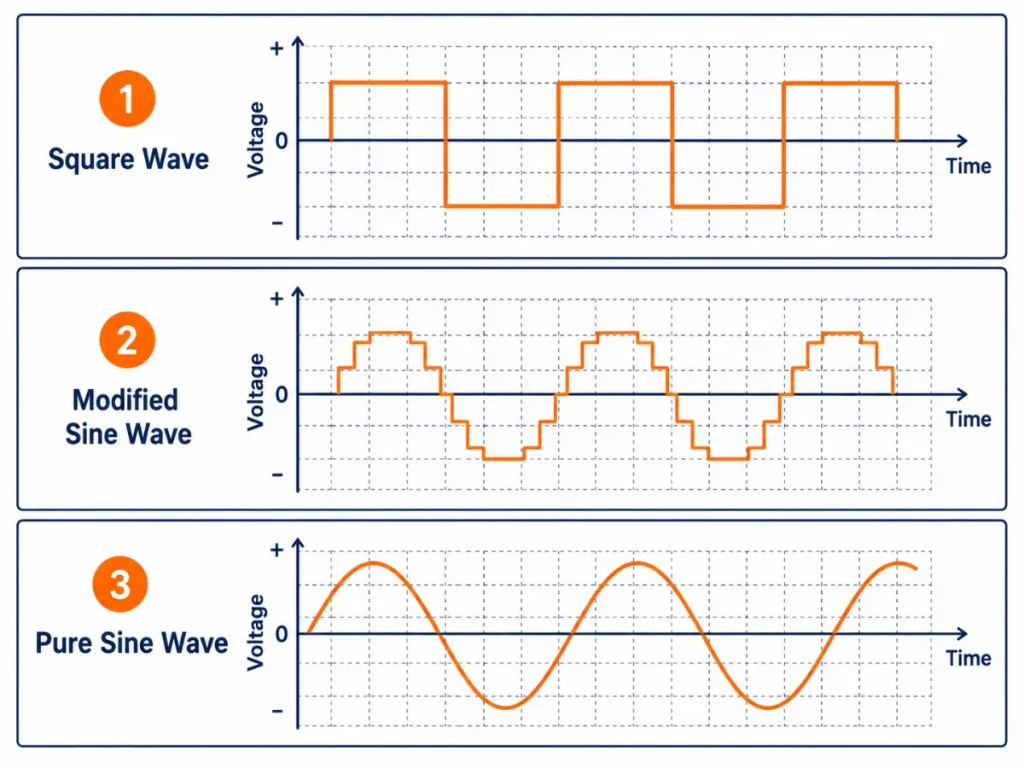
If you search for “how does a power inverter work,” the waveform type is often the key to understanding the answer. So, how does an inverter work differently across price ranges? In most cases, the quality and type of waveform make the real difference, not the brand name on the box.
Frequently Asked Questions
How does an inverter work step by step?
An inverter takes in DC power, switches it rapidly using transistors, shapes the result into a wave using pulse width modulation, steps up the voltage with a transformer, and filters the output into usable AC power.
Does an inverter give AC or DC output?
An inverter outputs AC power. It takes DC power as input and converts it through switching and filtering, providing alternating current that matches standard household electricity.
How does a 12V to 240V inverter work?
A 12V inverter uses transistors to switch the low DC voltage into pulses, then a transformer steps that voltage up to 240V, matching the standard household supply used in many countries outside North America.
Research
Research for this article was supported by publications from the U.S. Department of Energy, which confirm that an inverter converts DC to AC by switching the input’s direction rapidly, then filtering it into a clean sine wave for the grid. A 2013 report for the California Public Utilities Commission found that modern inverters typically reach upwards of 90 percent weighted power conversion efficiency.