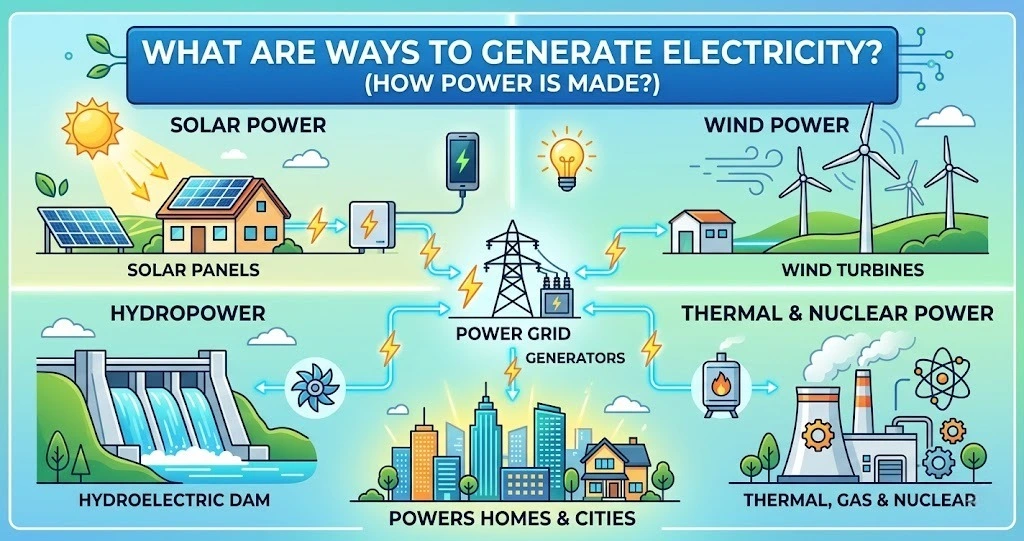
Solar panels work by capturing sunlight and converting it into electricity through a process called the photovoltaic effect. Sunlight hits silicon cells inside the panel, knocks electrons loose, and creates a flow of DC electricity. An inverter then changes that DC power into the AC power your home actually uses. That’s the whole trick. No mirrors. No magic. Just physics doing physics.
Key Takeaways
- Solar panels convert sunlight into electricity using the photovoltaic effect, a process discovered back in 1839.
- A single 400-watt panel typically produces 1.5–1.8 kWh per day, depending on your location’s sunlight.
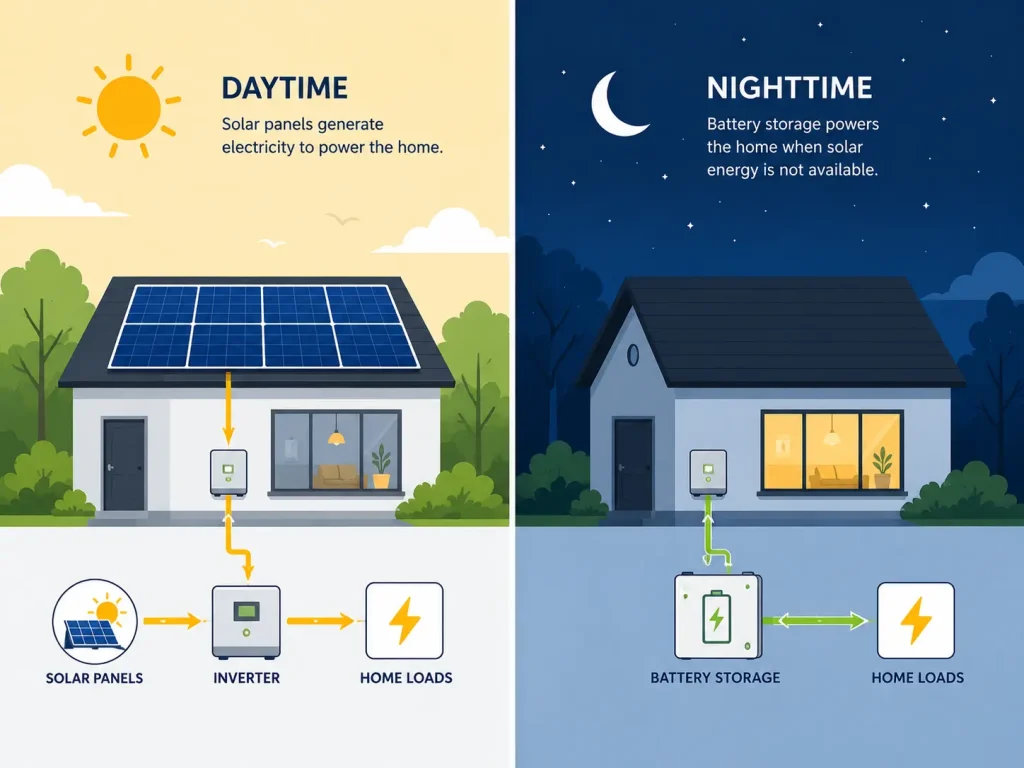
- Solar panels don’t generate power at night; batteries or the grid pick up the slack instead.
- Most residential panels today are rated between 350 and 450 watts, up from 250–300 watts a decade ago.
What Is a Solar Panel?
A solar panel is a collection of photovoltaic (PV) cells usually made from silicon that turn sunlight into usable electricity. Several cells are wired together in one panel, and several panels are wired together to make a solar array. Put one on your roof, and it starts generating power the moment the sun comes up.
Solar panels are sometimes called solar modules or PV panels, different names for the same device. Whether it’s mounted on a residential roof or spread across acres in a solar farm, the underlying technology works the same way.
Simple enough. The interesting part is what happens inside that panel once light hits it.
How Do Solar Panels Work? (The Photovoltaic Effect)
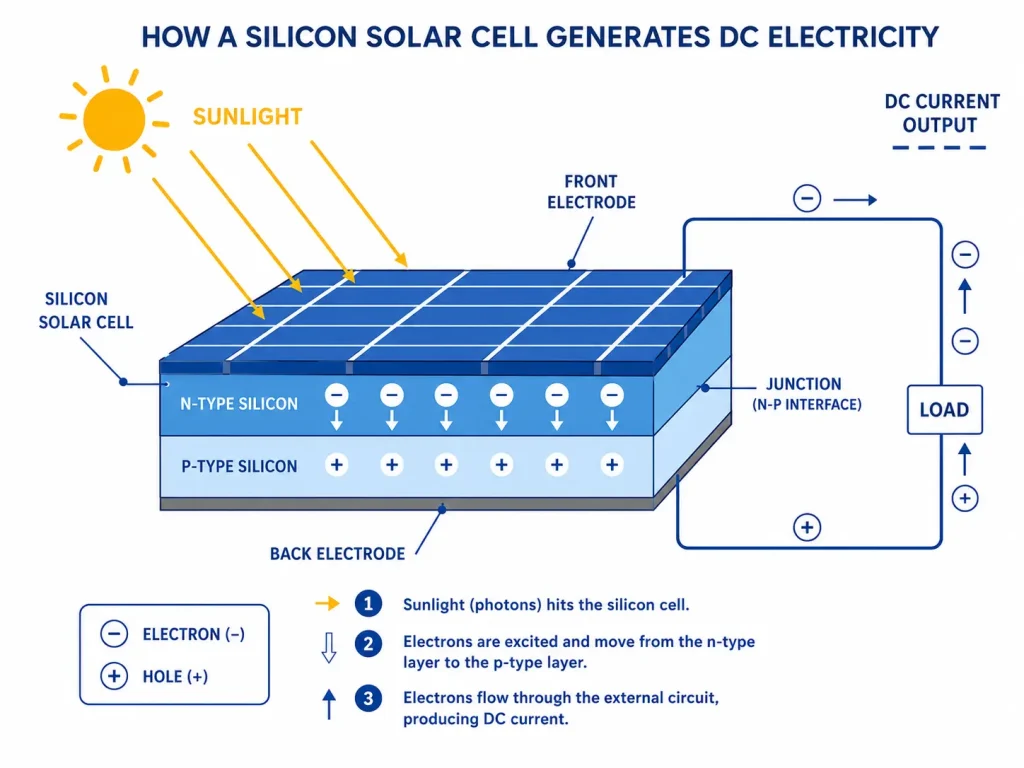
The physics behind this goes back further than most people expect. In 1839, a 19-year-old French physicist named Edmond Becquerel discovered that certain materials produce a small electric current when exposed to light. He called it the photovoltaic effect, and that same principle drives every rooftop solar system installed today.
Here’s the full process, step by step:
- Sunlight (photons) strikes the silicon cells in the panel.
- Photons knock electrons out of their atoms. This is the photovoltaic effect in action.
- The cell’s built-in electric field (the p-n junction) pushes those free electrons in one direction, creating a directed flow.
- That flow is direct current (DC) electricity.
- An inverter converts DC into alternating current (AC), the form your appliances actually use.
- AC electricity flows to your home’s electrical panel, powering everything from the fridge to the phone charger.
The p-n junction is the real engine of this solar panel explanation. Silicon gets “doped,” deliberately mixed with two different elements: phosphorus on the n-side (which contributes extra electrons) and boron on the p-side (which creates “holes,” or electron vacancies). Where those two layers meet, a built-in electric field forms. It acts like a one-way gate, forcing freed electrons to flow in a single direction rather than scattering randomly. That directed flow is your electricity.
No spinning turbines. No exhaust. No fuel bill. Just a silent electric field doing its job every time the sun comes up.
What Are Solar Panels Made Of?
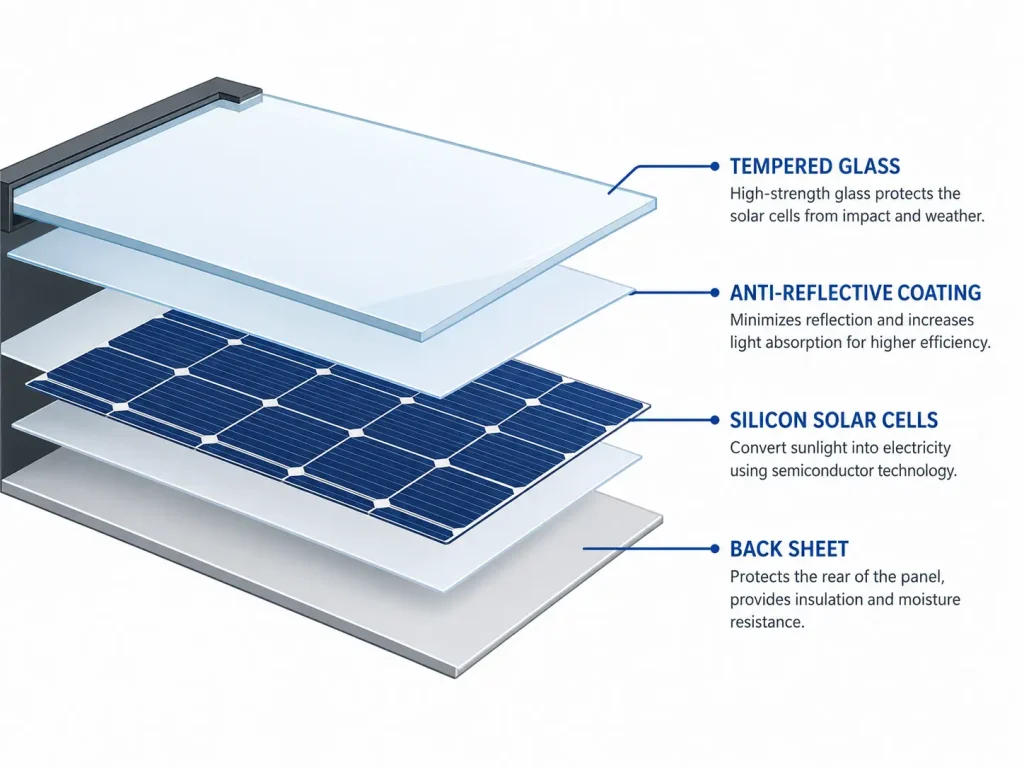
A solar panel isn’t just a flat sheet of silicon. It’s a stack of materials, each doing a specific job:
- Solar cells
Usually monocrystalline or polycrystalline silicon does the actual work of converting sunlight into electricity. Monocrystalline cells are cut from a single silicon crystal, give electrons more room to move, and tend to be more efficient, though also more expensive. Polycrystalline cells are made from fused silicon fragments, cost less, and perform slightly less efficiently.
- Glass casing
Protects the cells from rain, hail, and everyday wear without blocking sunlight.
- An anti-reflective coating
Helps the panel absorb more light instead of bouncing it away, the same idea behind coatings on camera lenses.
- A back sheet and insulation layer
Sit underneath the cells, protecting against heat buildup and moisture.
- Metal wiring
It connects the cells and carries the electrical current out to the inverter.
There’s also a smaller category worth knowing: thin-film solar cells, made from materials like cadmium telluride or amorphous silicon instead of traditional silicon wafers. They’re lighter and more flexible, which makes them useful for certain applications, but they’re generally less efficient than standard silicon panels and less common on residential rooftops.
How Much Energy Does a Solar Panel Produce?
This is where things get genuinely useful, because “produces electricity” doesn’t tell you much on its own.
Most residential solar panels sold today are rated between 350 and 450 watts. That rating is a lab measurement, though. Real-world output depends on your location’s peak sun hours, which range from about 4 hours a day in cloudier regions like the Pacific Northwest to 6+ hours in sunnier states like Arizona, according to data from the National Renewable Energy Laboratory.
Here’s what that looks like in practice for a single 400-watt panel:
| Peak Sun Hours/Day | Daily Output | Annual Output |
| 4 hours (cloudier regions) | ~1.5 kWh | ~500–550 kWh |
| 5 hours (US average) | ~1.7 kWh | ~600–650 kWh |
| 6+ hours (sunny regions) | ~2.0 kWh | ~700+ kWh |
For context, the average U.S. household uses around 875 kWh of electricity per month, based on EIA residential consumption data. That’s why homes typically install 15–25 panels rather than relying on one; a single panel covers a fridge and a few light bulbs, not a whole house.
How Do Solar Panels Work on a House?
Solar panels work on a house the same way they work anywhere else through the photovoltaic effect, just placed and angled for a specific roof. Installers point the panels toward true south in the Northern Hemisphere and angle them to match the home’s latitude for the most direct sun. Roof angle, shading from trees or chimneys, and available roof space all affect how many panels fit and how much electricity the system produces.
All the panels on the roof connect to one central inverter or a few smaller inverters, which combine their power and turn it into the electricity your home’s breaker box actually sends to your outlets and appliances. From there the system either sends extra power back to the utility company for a bill credit or stores it in a battery, the same nighttime setup covered above.
How Long Do Solar Panels Last?
Most residential solar panels come with a 25-year performance warranty, and many keep producing usable electricity well beyond that. Panels don’t stop working after 25 years; they just degrade slowly. Industry data shows silicon panels typically lose about 0.4–0.5% of their output per year, meaning a panel still produces roughly 87% of its original power after 25 years.
That slow decline is one reason solar is considered a long-term investment rather than a quick fix. A system installed today will still be meaningfully productive when your mortgage is paid off.
Do Solar Panels Work at Night?
Short answer: no. Solar panels need sunlight to generate electricity, and there’s not much of that at 2 a.m.
That doesn’t mean your lights go off at sunset, though. Homes with solar typically handle nighttime power in one of two ways:
- Grid-tied systems
Pull electricity from the regular utility grid once the sun goes down, often with net metering credits offsetting the cost based on what you produced during the day.
- Battery storage systems
Store excess daytime energy and release it at night, giving you power independent of the grid.
So the panels themselves clock out at sunset. The system around them keeps working.
Frequently Asked Questions
How do solar panels work, explained simply?
Sunlight hits the panel and knocks electrons loose inside silicon cells, and that movement creates electricity. An inverter then converts it into the power type your home uses. That’s the whole process, minus the technical detail.
Do solar panels work on cloudy days?
Yes, though at reduced output. Panels still generate electricity from diffused sunlight on overcast days, typically 10–25% of their clear-sky output, depending on cloud thickness.
Can solar panels work without an inverter?
No. Panels produce DC electricity, and virtually all home appliances run on AC. Without an inverter, the power generated can’t be used in a standard household.
Conclusion
So, how do solar panels work? Sunlight strikes silicon cells, electrons get moving, and that motion becomes usable electricity, converted from DC to AC along the way by an inverter.
A single panel won’t power your whole house, but a properly sized array, paired with the grid or a battery for nighttime coverage, absolutely can. It’s a remarkably simple piece of physics doing a genuinely big job.
Research
Research for this article was supported by publications from the U.S. Department of Energy (DOE), National Renewable Energy Laboratory (NREL), and U.S. Energy Information Administration (EIA).