How do wind turbines generate electricity? For centuries people stood in front of windmills, watched the blades spin, and thought, useful. It was not until 1887 that Scottish engineer James Blyth wired one up to a battery and light his cottage. That was the first recorded use of wind to generate electricity. Over a hundred years later, we’re putting turbines the size of skyscrapers in the ocean to power entire cities.
So how does a wind turbine actually produce electricity? Not the one-liner. The actual answer.
Wind Is Moving Air, and Moving Air Has Energy
Before anything else, you need to understand what a turbine is working with.
Wind is air in motion. Air has mass. Mass in motion carries kinetic energy. A wind turbine’s job is to pull that kinetic energy out of the moving air and convert it into electricity. That’s the whole premise.
Wind itself forms because the sun heats the earth unevenly. Land warms faster than water. The equator gets more heat than the poles. Hot air rises, and cooler air moves in to fill the gap that movement is wind.
According to the U.S. Department of Energy, three things drive wind patterns: uneven solar heating of the atmosphere, the physical shape of the earth’s surface, and the planet’s rotation.
This matters because it tells you something useful: wind is predictable in the right locations. Coastal zones, open plains, mountain ridges, and valley passes, these spots see consistent winds because of how terrain and water interact with that solar-driven air movement.
How a Wind Turbine Works (Step by Step)
Here’s the full process, from gust to grid.
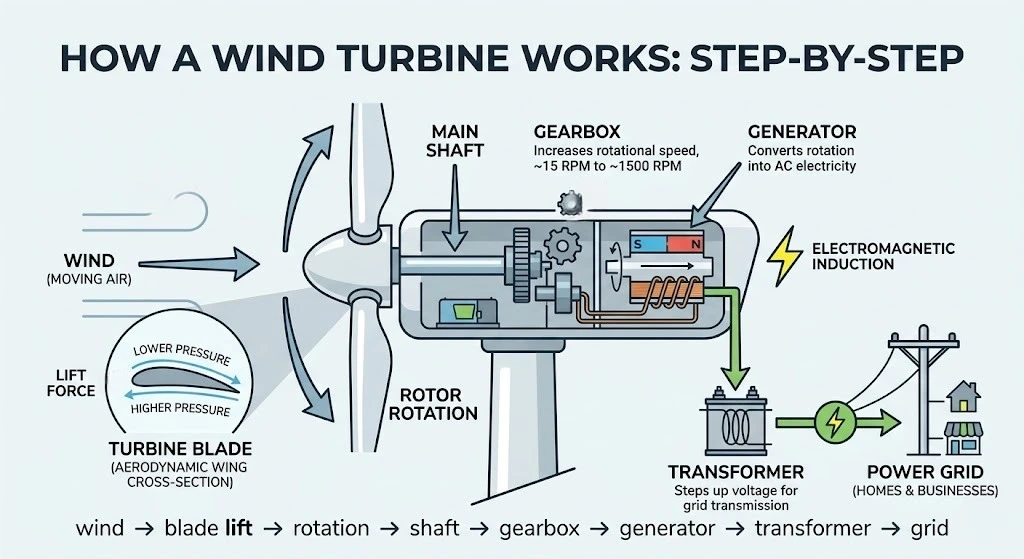
The blades catch the wind and start spinning.
A modern turbine blade isn’t a flat paddle. It’s shaped like an aircraft wing. When wind flows across the curved surface. It creates a pressure difference between the two sides. Lower pressure on one side pulls the blade forward. That’s a lift. The same physics that keeps a plane airborne makes turbine blades rotate.
The U.S. Department of Energy explains this directly: the lift force is stronger than the drag, and this imbalance causes the rotor to turn. No combustion. No heat. Just air pressure doing mechanical work.
The rotor turns a shaft.
The spinning blades are attached to a hub that attaches to a main shaft that runs into the nacelle, the big housing unit at the top of the tower. This shaft turns at the same speed as the blades, 10 to 20 revolutions per minute (RPM) for large utility turbines.
A gearbox multiplies the rotation speed.
Ten to twenty RPM is too slow to efficiently drive a generator. Most turbines have a gearbox to boost that speed to around 1,000–1,800 RPM. It’s like a mechanical translator, where fast, high-torque rotation comes in and slower torque rotation comes out.
Some modern turbines skip the gearbox entirely. These “direct-drive” designs use a larger generator built to work at low RPM. Fewer moving parts means lower maintenance costs, which is why this design is becoming more common in offshore installations.
The wind turbine electric generator converts rotation into electricity.
Once the shaft spins at working speed, it drives the generator. Inside the generator, a rotor with magnets spins past coils of copper wire. That spinning magnetic field pushes electrons through the wire, producing alternating current (AC). This is electromagnetic induction, the principle Michael Faraday demonstrated in 1831.
The generator is what actually answers how a wind turbine generates electricity. Everything before it, the blades, shaft, and gearbox, exists to give the generator a rotating shaft at the right speed.
A transformer adjusts the voltage for the grid.
Raw generator output gets stepped up to high voltage before transmission. High voltage means lower current, which means less energy lost as heat in the cables. A transformer handles this, and substations further along the grid step the voltage back down to safe levels for homes and businesses.
The full chain:
wind → blade lift → rotation → shaft → gearbox → generator → transformer → grid.
How Much Electricity Can One Wind Turbine Generate?
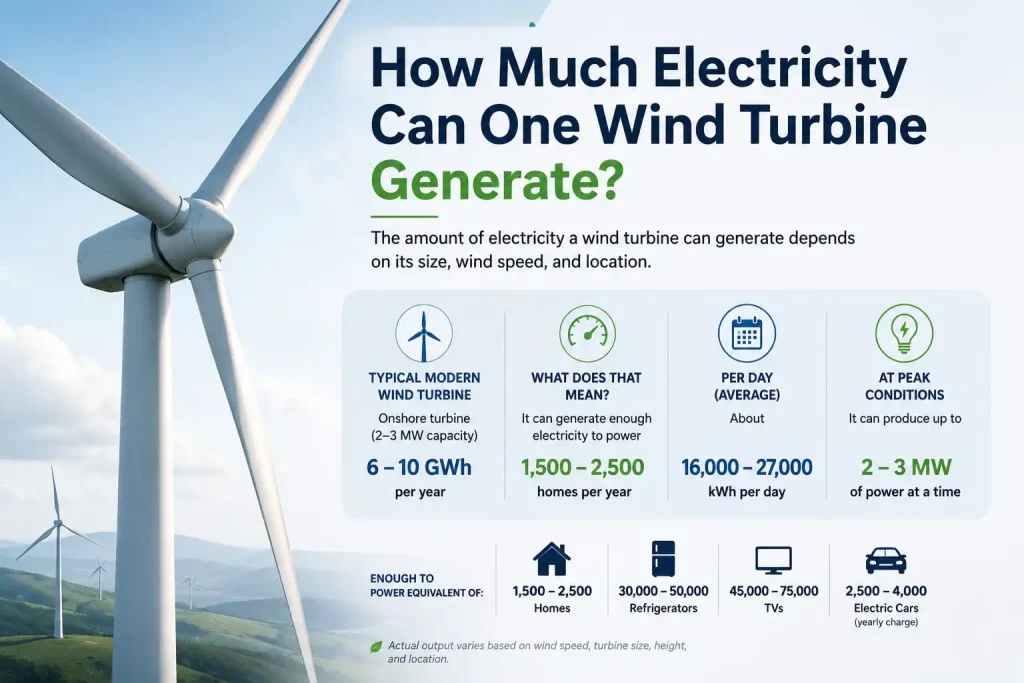
The honest answer depends on turbine size and local wind conditions, and the range is wider than most people expect.
According to the U.S. Energy Information Administration (EIA), small wind turbines sized for a single home produce around 10 kilowatts (kW). The largest turbines currently operating reach up to 15,000 kW (15 MW), with even bigger designs in development.
A typical utility-scale land turbine sits in the 2–3 MW range. At that output, running at average wind speeds across a year, one turbine can supply enough electricity for roughly 400–500 homes.
Here’s something most articles skip entirely: wind output doesn’t scale evenly with wind speed. It scales with the cube of wind speed. Double the wind speed, and you get eight times the power output. This is why site selection matters so much. A location averaging 15 mph produces dramatically more electricity than one averaging 12 mph, even though three miles per hour sounds like a small gap.
The EIA data tells the growth story clearly: total U.S. wind electricity generation grew from about 6 billion kilowatt-hours in 2000 to roughly 435 billion kWh in 2022, reaching around 10.2% of total U.S. utility-scale electricity generation. That’s a 70-fold increase in just over twenty years.
Horizontal Axis Wind Turbine vs. Vertical Axis Wind Turbine
Not all turbines are equal, and the design difference is more than just looks.
Horizontal-Axis Wind Turbines (HAWT)
This is the kind of turbine you think of when someone says “wind farm.” It’s a tall tower with three long blades, facing into the wind. The rotation axis is parallel to the ground and parallel to the wind direction.
The industry is dominated by HAWTs because they produce more electricity per unit of material and space than any other design. The EIA confirms that nearly all wind turbines currently in commercial operation fall under this type.
The largest HAWTs stand as tall as 20-story buildings with blades stretching over 100 feet. Taller towers and longer blades consistently produce more electricity taller because wind speed increases with height above the ground and longer because the sweep area of the rotor determines how much air the blades intercept per rotation.
Most utility HAWTs operate “upwind” the blades face directly into the wind, and the entire nacelle rotates automatically to track wind direction. A yaw drive managed by real-time wind sensors handles this adjustment continuously.
Vertical-Axis Wind Turbines (VAWT)
Vertical-axis designs have a rotor shaft perpendicular to the ground. The most popular type is the Darrieus turbine, patented in 1931 by French engineer Georges Darrieus, which looks like a giant curved egg beater.
The only real advantage of VAWTs is that they work whichever way the wind is blowing. No yaw drive is needed. So this makes them worth considering in the urban setting where the wind is turbulent and changing all the time.
The drawbacks are significant, though. Lower energy output per swept area, faster wear from uneven aerodynamic loading, and years of commercial underperformance compared to HAWTs. The EIA notes that very few vertical-axis turbines operate at commercial scale today.
The horizontal-axis design is best on all practical counts for utility power generation.
What’s Actually Inside the Nacelle?
Most articles show you the outside of a turbine. The nacelle is where the real engineering sits.
The nacelle is the housing at the top of the tower. Depending on the turbine, it can weigh anywhere from 60 to over 400 tonnes. Everything that converts rotation into usable electricity lives inside it.
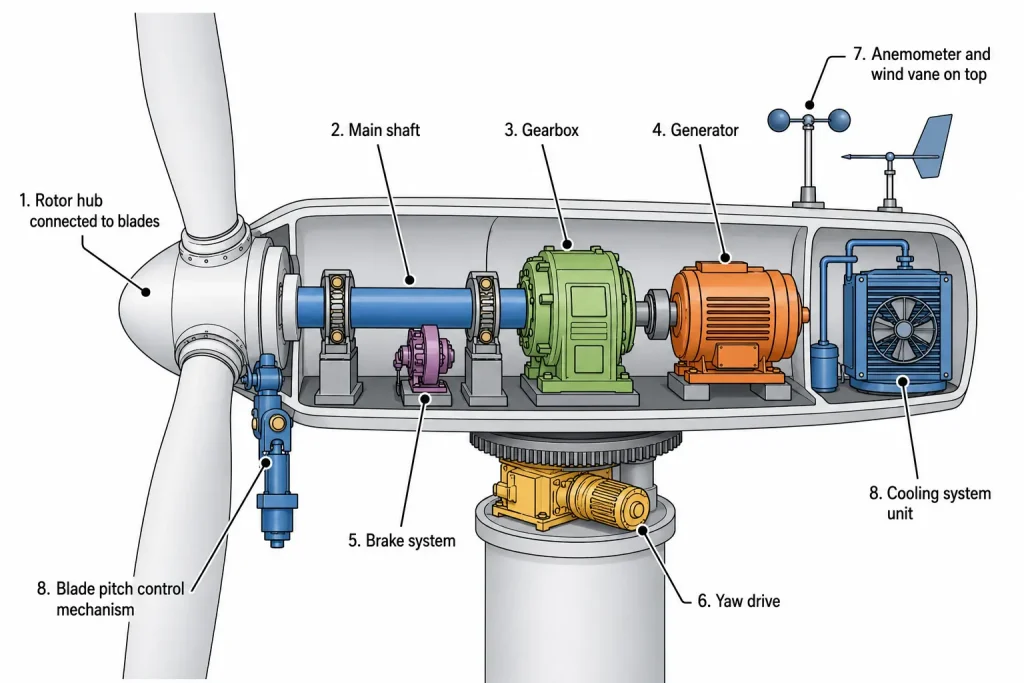
Inside a standard HAWT nacelle, you’ll find:
- Main shaft
Connects the rotor hub to the gearbox
- Gearbox
Steps shaft speed from ~15 RPM to ~1,500 RPM
- Generator
Converts mechanical rotation into AC electrical current
- Brake system
Stops the rotor during maintenance or severe weather
- Yaw drive
Rotates the nacelle to face wind direction
- Anemometer and wind vane
Measures wind speed and direction in real time
- Blade pitch control
Adjusts each blade’s angle to regulate power output and protect the turbine in high winds
- Cooling system
Keeps the gearbox and generator within safe temperature limits
The pitch control system is worth noting separately. Blades don’t stay locked at a fixed angle. They rotate along their own axis to vary the amount of lift they generate. At low wind speeds, blades pitch to catch maximum lift.
When wind gets too strong, blades rotate nearly flat to shed excess energy and avoid structural overload. The turbine’s onboard control system manages this automatically and continuously.
Where Wind Turbines Work Best
Wind farm location isn’t chosen randomly. It follows rigorous site assessments using measured wind data collected over months or years before construction starts.
The EIA notes that utility-scale turbines need sites with average wind speeds of at least 13 mph (5.8 m/s). Smaller turbines can work at lower speeds, but the economics still require consistent airflow to justify the investment.
The best locations include smooth hilltops, open flat plains, coastlines, and mountain passes that concentrate and channel airflow. And this is why Texas, Iowa, Oklahoma, Kansas, and Illinois together produced roughly 57% of all wind power in the U.S. in 2022. The expansive landscape of the Great Plains provides turbines with broad, unencumbered access to consistent wind.
Offshore sites push this further. Ocean winds are stronger, more consistent, and less turbulent than land winds. The installation cost is higher foundations for offshore structures are expensive, but the energy yield justifies it. This is why offshore turbines keep growing in size: more output per installation means better economics.
Wind Power in Context
Understanding how wind turbines generate electricity means more when you see where wind fits in the bigger picture.
Wind produces zero emissions during operation and uses no water for cooling, two advantages that coal, natural gas, and nuclear generation all lack to varying degrees. Operating costs after installation are low because there’s no fuel to buy.
The main limitation is that wind doesn’t blow at a constant speed. Turbines shut down below about 8 mph and above roughly 55 mph. Grid operators handle this by combining wind with other generation sources and increasingly with battery storage.
Wind generation also tends to peak in winter and at night, which pairs well with solar, which peaks in summer and during daylight hours. A grid that mixes wind, solar, and storage handles demand more reliably than either renewable source alone.
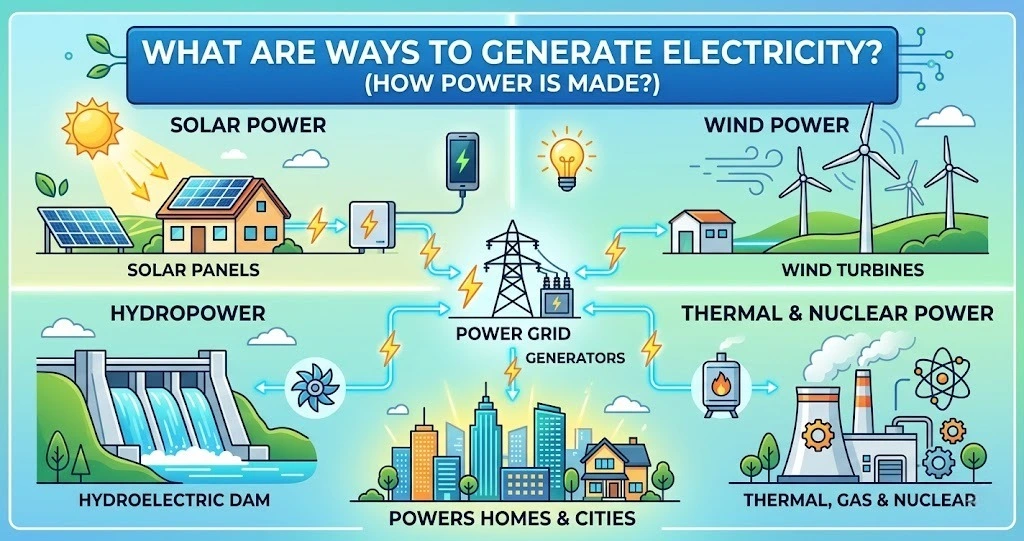
For a broader look at how wind fits alongside hydro, nuclear, solar, and fossil fuels in the full electricity mix, our piece on all types of power generation covers each method in detail.
Key Facts at a Glance
All figures from the U.S. EIA and U.S. Department of Energy:
- Wind supplied roughly 10.2% of total U.S. utility-scale electricity in 2022
- China led global wind generation in 2021 at 34%, with the U.S. second at 21%
- At least 128 countries were generating wind electricity by 2021
- The largest operating turbines reach 15 MW of generating capacity
- U.S. wind generation grew roughly 70-fold between 2000 and 2022
- Wind turbines are designed to last 20–25 years
- Turbines produce zero emissions during normal operation
Frequently Asked Questions:
Why do wind turbines have 3 blades and not 2 or 4?
Three blades are a compromise between efficiency and stability and cost. Two blades vibrate, and four blades add weight and no real gain in output. Three became the norm after decades of real-world testing.
What wind speed does a turbine need to start generating electricity?
Most turbines start at 6–9 mph (cut-in speed) and shut down above roughly 55 mph to avoid damage. The American Clean Power Association says modern turbines produce usable electricity over 90% of the time across a full year.
Can a wind turbine generate electricity without wind?
No. No wind means no blade rotation, no shaft movement, no electricity. This is why wind power is paired with other generation sources or battery storage on the grid.
Do wind turbines use electricity to run themselves?
Yes, but very little, about 0.3% of their total production, is used for internal systems like sensors, pitch motors, and cooling. It’s a small overhead.
How long does a wind turbine last?
20 to 25 years, with turbines running up to 120,000 hours over their lifetime, roughly 20 times longer than a car engine, according to the European Wind Energy Association.
Conclusion
A wind turbine is an aerodynamic machine first and an electrical machine second. The blades extract kinetic energy from moving air through lift. That rotation transfers through a shaft, gets multiplied by a gearbox, and drives a generator that uses electromagnetic induction to produce alternating current.
The chain from Faraday’s original principle to a modern 15 MW offshore turbine is the same in all material respects. What’s changed is the scale and the accuracy and the sheer amount of electricity a single machine can now push out.
So, whether you are an engineering student, a professional, or just someone who drives past wind farms and wonders what’s going on up there, now you know exactly how it works.